Georgia: The Ancient Homeland of Wine

Before orange wine became the darling of natural wine bars in London, Georgia had already been making it for roughly 8,000 years.
Long before skin-contact wines became fashionable, Georgian winemakers were fermenting white grapes with their skins, seeds and stems inside underground clay vessels known as ‘qvevri’, creating the amber-hued wines now poured obsessively across modern restaurant wine lists. In Georgia, however, it was never a trend. It was simply tradition.
Travelling through Georgia is less about checking wineries off an itinerary and more about understanding how wine became inseparable from everyday life. In this small Caucasus nation, wine is history, identity and ritual all at once. Archaeological evidence suggests Georgia is one of the oldest wine-producing countries in the world, with winemaking traditions dating back roughly 8,000 years.
Yet despite this extraordinary heritage, Georgia still feels wonderfully underexplored. That is part of its charm.
For wine lovers, the country offers something genuinely different: indigenous grape varieties found nowhere else, ancient qvevri winemaking techniques recognised by UNESCO, dramatic mountain landscapes and a cuisine shaped by influences from Persia, Turkey, Russia and the Silk Road.
Georgia is not simply another wine destination. It is a place where wine culture was born and never truly industrialised out of daily life.
Tbilisi: Europe Meets Asia Over a Glass of Amber Wine
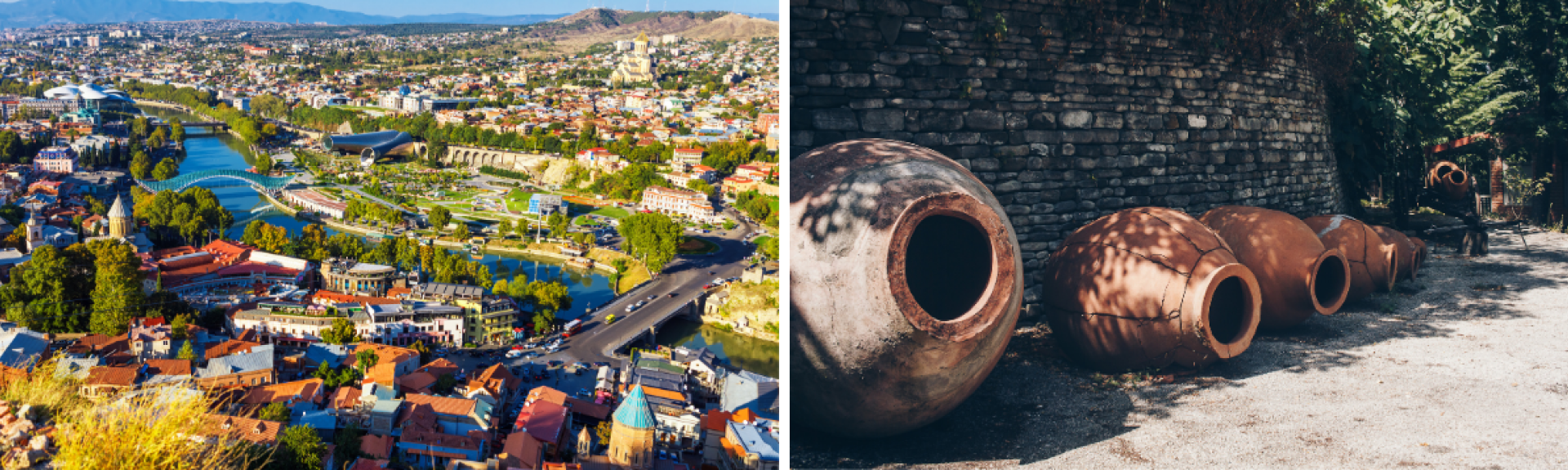
Most journeys through Georgia begin in Tbilisi, a capital that somehow feels both ancient and youthful. Ornate balconies lean over narrow cobbled streets, Soviet architecture stands beside art nouveau facades, and sulphur bathhouses sit beneath hilltop churches.
The city’s energy mirrors Georgia itself: a crossroads between East and West.
Wine bars and cellar restaurants are woven throughout the city, particularly in the old town, where amber wines are poured beside traditional dishes and contemporary Georgian cooking. The country’s natural wine movement has also found a strong foothold here, attracting sommeliers and adventurous drinkers from across Europe.
Georgia’s wine culture differs dramatically from the polished tasting flights common in Bordeaux or Napa. Wine is communal. Tables are abundant with food. To truly understand Georgian hospitality, you need to experience a supra: the traditional Georgian feast. Led by a tamada (toastmaster), a supra is an evening of endless courses, wine and elaborate toasts dedicated to friendship, family, peace and memory.
Kakheti: The Heartbeat of Georgian Wine
While wine is made throughout the country, the eastern region of Kakheti remains the spiritual centre of Georgian winemaking.
Rolling vineyards stretch towards the Caucasus Mountains, monasteries rise above fertile valleys, and nearly every family seems to make wine in some form. According to local guides, winemaking here predates many of the world’s earliest civilisations.
Driving through Kakheti feels wonderfully uncommercial compared with more established European wine regions. Small roadside stalls sell homemade churchkhela (candle-shaped sweets made from nuts and grape must) alongside honey, spices and plastic bottles filled with family-produced wine.
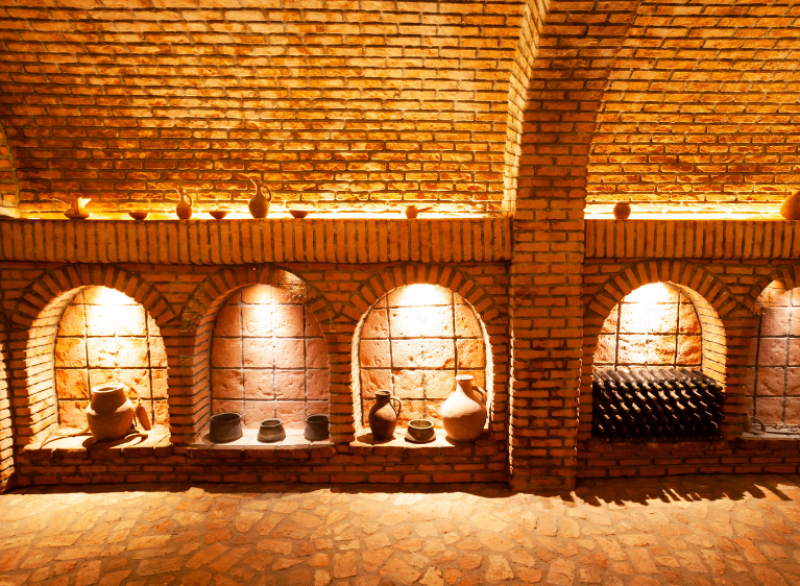
Many wineries are still family-run maranis (wine cellars), where tastings take place in gardens rather than in architect-designed visitor centres.
The region is also where travellers truly encounter Georgia’s most famous contribution to wine: qvevri winemaking.
Qvevri: Georgia’s Ancient Clay Tradition
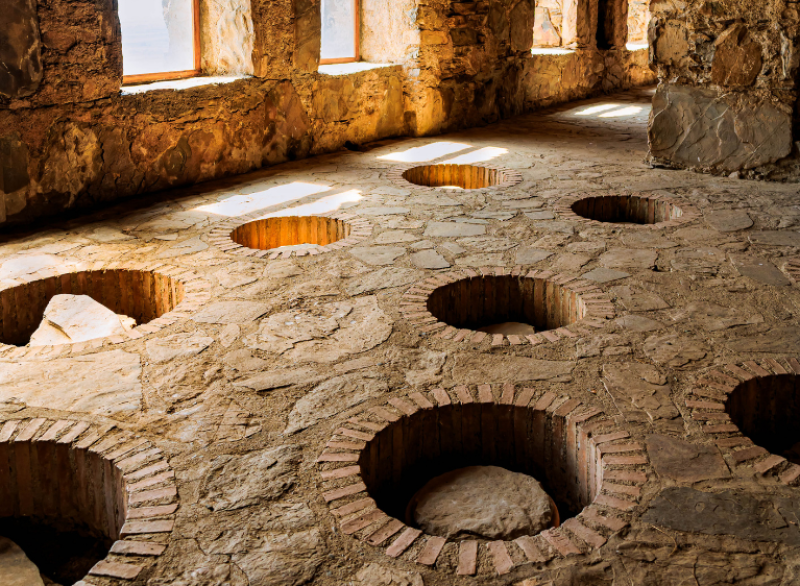
The qvevri method is central to Georgian wine identity. Large egg-shaped clay vessels, known as qvevri or kvevri, are buried underground and used for fermentation, ageing and storage.
The technique has remained largely unchanged for centuries.
White grapes are often fermented with skins, seeds, and stems in buried clay vessels, producing amber- or orange-coloured wines that have become increasingly influential in the modern natural wine movement. These wines can be textured, tannic, savoury, and deeply complex, and are more structurally akin to red wine than conventional whites.
For many travellers, tasting authentic qvevri wines in Georgia becomes a revelation. The wines feel raw and alive, carrying earthy textures and tea-like tannins that reflect both ancient tradition and minimal-intervention philosophy.
Georgia’s indigenous grape varieties only deepen the intrigue. Saperavi, one of the country’s most important red grapes, produces deeply coloured wines with dark fruit and spice. Rkatsiteli delivers freshness and structure, while varieties such as Kisi and Mtsvane are increasingly attracting international attention among sommeliers and collectors.
In recent years, Georgia’s traditional methods have gained global recognition, particularly within the natural wine scene. Producers focused on organic farming and low-intervention techniques are helping reshape perceptions of Georgian wine beyond its Soviet-era reputation for bulk production.
But while international demand has grown, Georgian wine still feels refreshingly connected to place rather than trend.
The Cuisine: Comforting, Rich and Made for Wine
Part of what makes travelling through Georgia so compelling is how seamlessly the food and wine fit together.
Georgian cuisine reflects centuries of cultural exchange. Persian spices, Turkish grilling traditions, Russian influences and local mountain ingredients all appear across the country’s regional dishes.
And almost everything seems designed to accompany wine.
Khachapuri, Georgia’s famous cheese-filled bread, arrives in numerous regional forms, from the boat-shaped Adjarian version topped with egg and butter to simpler Imeretian styles. Khinkali dumplings, usually filled with spiced meat and broth, are eaten by hand and paired brilliantly with fresher reds or crisp amber wines.
Then there are walnut sauces flavoured with garlic and coriander, grilled meats cooked over charcoal, aubergine rolls filled with walnut paste and herb-laden salads dressed with Kakhetian sunflower oil.
Meals in Georgia rarely feel rushed. Tables expand continuously as more dishes appear, often accompanied by homemade wine poured generously, with little concern for formal tasting etiquette.
Beyond Kakheti: Georgia’s Diverse Wine Regions
While Kakheti dominates Georgian wine production, some of the country’s most fascinating wines come from its smaller regional appellations, where local grape varieties and distinct winemaking traditions continue to shape highly individual styles.
In western Georgia, Imereti produces lighter, more delicate expressions than the structured amber wines often associated with Kakheti. Here, producers traditionally use churi, western Georgia’s version of qvevri, but with shorter skin contact and fewer stems during fermentation. The result is fresher, more floral amber wines with softer tannins and brighter acidity. Indigenous varieties such as Tsitska, Krakhuna and Tsolikouri thrive in the region’s humid climate, producing wines that can feel surprisingly elegant and mineral-driven compared to their eastern counterparts.
Further north, the mountainous region of Racha is best known for Aleksandrouli and Mujuretuli. They are the two native grapes behind Khvanchkara, Georgia’s famed naturally semi-sweet red wine. The cool climate and steep vineyard sites help preserve acidity, balancing the wine’s ripe berry fruit and subtle sweetness. While semi-sweet styles remain the region’s signature, many producers are now experimenting with dry expressions and smaller-scale qvevri fermentations to highlight the grapes’ aromatic complexity and freshness.
Another increasingly important region is Kartli, situated around central Georgia near Tbilisi. Historically known for sparkling wine production during the Soviet era, the region is now gaining attention for vibrant whites made from Chinuri and Goruli Mtsvane. Chinuri, in particular, has become one of Georgia’s most exciting white grapes, capable of producing crisp, saline-driven wines with orchard fruit character and impressive ageing potential. Winemakers in Kartli often combine traditional qvevri techniques with European-style stainless-steel vinification, creating wines that bridge Georgia’s ancient heritage and a more contemporary style.
A Country Where Wine Still Feels Personal
What makes Georgia so memorable is not simply the age of its vineyards or the uniqueness of its wines, but the way wine remains inseparable from everyday life. Unlike many established wine destinations, Georgia has not polished away its traditions in pursuit of tourism. Wine is still made in family cellars, poured generously at the dinner table and celebrated through rituals that have endured for centuries.

For travellers, that authenticity becomes part of the experience. One moment you are tasting amber wines from buried clay vessels, the next you are sharing homemade food and stories with locals over a sprawling supra. The boundaries between hospitality, culture and winemaking blur effortlessly.
Georgia offers something increasingly rare in modern wine travel: a sense of discovery. From the earthy complexity of qvevri wines to the remarkable diversity of indigenous grape varieties, the country feels both ancient and excitingly relevant.
And perhaps that is why so many visitors leave slightly obsessed with it. Not because Georgia follows wine trends, but because it quietly reminds the rest of the wine world where many of those traditions began.

Related Articles

A Journey Through Burgundy: Four days on the Côte d’Or
By Tom Turner