Italy’s Top 10 Wines: The Bottles That Changed the Country
Any attempt to name Italy’s ten greatest wines is likely to start an argument before the corkscrew has left the drawer. Italy has hundreds of native grape varieties, fiercely individual regions and enough great producers to fill several lists.
To give the debate some structure, we have followed the order in which Italian wines appeared among the most searched names in Wine-Searcher’s Top 1000 in July 2026. It is a measure of attention rather than a critic’s scorecard, but attention at this level is rarely accidental.
This selection brings together the bottles that collectors, drinkers and curious wine lovers continue to seek out. Some broke long-established rules. Others proved that traditional methods, followed with almost unreasonable patience, could still produce wines of extraordinary finesse and longevity.
Tuscany dominates, reflecting the global influence of the Super Tuscan movement, while Piedmont supplies two monumental expressions of Nebbiolo. Together, these ten wines tell a story of rebellion, heritage, ambition and, occasionally, magnificent stubbornness.
1. Sassicaia, Tenuta San Guido
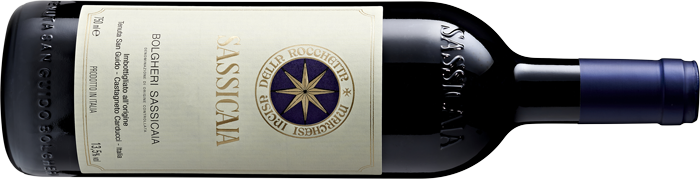
Sassicaia did not simply challenge Italy’s wine establishment. It eventually persuaded the establishment to create a denomination especially for it.
The story began in 1944, when Marchese Mario Incisa della Rocchetta planted Cabernet Sauvignon at Tenuta San Guido in Bolgheri. He believed the estate’s gravelly, stony soils bore a resemblance to those found in Bordeaux’s Graves region. The wine remained a private pleasure for the family and its guests for more than two decades. The 1968 vintage became the first commercial release, reaching the market in 1971.
Sassicaia is led by Cabernet Sauvignon, supported by Cabernet Franc. The vineyards sit at varying elevations and exposures across the estate, rather than occupying one neat, continuous block. Fermentation takes place in temperature-controlled tanks, followed by malolactic fermentation and extended maturation in French oak. The precise barrel programme changes with the vintage. The 2021, for example, spent 24 months in wood before further refinement in bottle.
Its rise from vino da tavola to Italian aristocracy remains one of wine’s great reversals of fortune. In 1978, the 1972 Sassicaia finished first in a Decanter blind tasting of 33 Cabernet-based wines from around the world. In 1994, its production area became a subzone of Bolgheri DOC. Full independence followed in 2013, creating Bolgheri Sassicaia DOC, the only Italian denomination reserved for one wine from one estate within a defined vineyard area.
Annual production is generally estimated at around 180,000 bottles, although difficult vintages can yield considerably less. That makes Sassicaia scarce by global standards, but sufficiently available to have become both a collector’s wine and the international calling card of Bolgheri.
2. Tignanello, Marchesi Antinori
If Sassicaia proved that Bordeaux varieties could thrive on the Tuscan coast, Tignanello took the argument into the heart of Chianti Classico.
The wine comes from a 77-hectare vineyard on the Antinori family’s Tignanello estate, between the Greve and Pesa valleys. Its soils are rich in limestone, and the vines sit between approximately 350 and 400 metres above sea level.
The first experimental version was made in 1970 as Chianti Classico Riserva Vigneto Tignanello. That original blend still contained Canaiolo and the white grapes Trebbiano and Malvasia. In 1971, the wine became Tignanello and was sold as a simple Tuscan table wine. White grapes were removed completely in 1975, and the familiar combination of Sangiovese, Cabernet Sauvignon and Cabernet Franc has been used since 1982.
Tignanello was the first Sangiovese of its kind to be matured in barriques and one of the first major Chianti Classico reds to dispense with white grapes. Its willingness to accept a lowly classification in pursuit of better wine helped inspire the loose group of rule-breaking Tuscan reds that became known as Super Tuscans.
The modern process is exacting but not heavy-handed. Grapes are sorted carefully, fermented in truncated conical tanks and macerated with close attention to aroma and tannin quality. Malolactic fermentation takes place in small oak barrels. The 2023 spent 13 months in predominantly new French oak, with a small proportion of Hungarian oak, followed by another 12 months in bottle.
Around 300,000 to 340,000 bottles are normally produced in a vintage, making Tignanello the most widely available wine in this group. That has done little to diminish its status. It is a rare example of a genuinely important wine produced in enough quantity for people to drink rather than merely discuss.
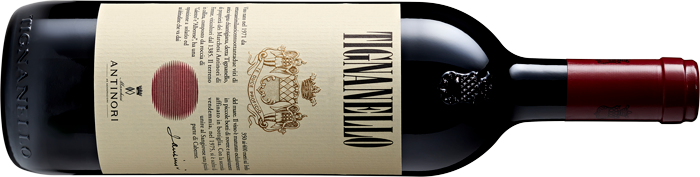
Even the label has a story. It was created by the Italian designer Silvio Coppola for the release of the 1971 vintage. Piero Antinori then asked his father, Niccolò, to sign it, acknowledging the trust he had placed in his son’s highly unconventional project.
3. Masseto
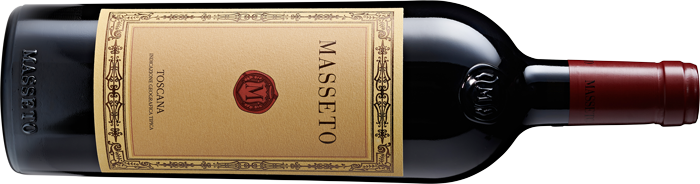
Masseto is Tuscany’s answer to the question of what happens when Merlot finds exactly the right patch of clay.
Its vineyard lies on a hill close to the Tyrrhenian coast, where ancient marine deposits have created dense layers of grey and blue clay. Some of that clay hardens into rock-like clumps known locally as massi, providing the wine with its name. Merlot can lose freshness and structure in the wrong conditions, but here the clay retains moisture, restricts vigour and allows the grapes to ripen slowly while developing formidable concentration.
Each section of the vineyard is harvested and vinified separately. Recent vintages have been fermented spontaneously with indigenous yeasts, increasingly in concrete vessels. Malolactic fermentation takes place in new oak, with the component lots matured separately before the final blend is assembled. A typical release spends around 24 months in barriques, followed by further ageing in bottle.
For many years Masseto was made within the Ornellaia winery. It now has a dedicated, gravity-fed cellar of its own, much of it built underground and visually connected to the blue clay that defines the vineyard. The winery officially opened in 2019, with concrete fermentation forming an increasingly important part of the estate’s approach.
Despite the vineyard expanding over time, production has remained remarkably restricted. Recent estimates place annual output at around 30,000 to 34,000 bottles. Massetino, the estate’s second wine, absorbs fruit that does not enter the final Masseto blend and allows the grand vin to remain ruthlessly selective.
Masseto is often compared with Pétrus because both are clay-grown Merlots with tiny production and formidable prices. The comparison is understandable, but Masseto does not taste like a Tuscan imitation of Bordeaux. Its ripeness, Mediterranean warmth and savoury character make its origins quite clear.
4. Ornellaia
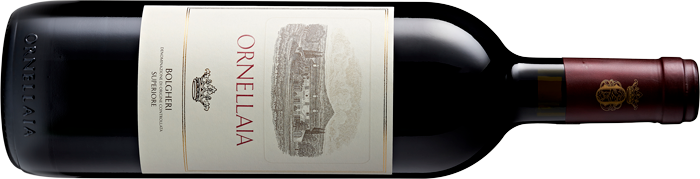
Ornellaia shares Bolgheri with Sassicaia and an estate history with Masseto, yet it has always possessed its own personality.
The estate was established in 1981, with the first vintage of Ornellaia produced in 1985. It is now owned by the Frescobaldi family. The wine is a Cabernet Sauvignon-led blend, usually accompanied by Merlot, Cabernet Franc and Petit Verdot, although the proportions are adjusted according to the conditions of each vintage.
The separate vineyard parcels and grape varieties are vinified individually. Fermentation generally takes place in stainless steel or concrete at controlled temperatures, followed by maceration lasting roughly two weeks. Malolactic fermentation is completed largely in barriques. A representative recent vintage spent 18 months in oak, with the initial lots blended after 12 months and returned to barrel for a further six. Another year in bottle followed before release.
Ornellaia is polished and powerful, but its best vintages avoid becoming a simple display of ripeness. The estate has gradually placed greater emphasis on freshness, parcel definition and tannin quality, allowing the wine’s Mediterranean character to show through its Bordeaux vocabulary.
Typical production is around 140,000 bottles, placing it close to Sassicaia in scale and well above Masseto. The volume remains modest given the wine’s global distribution and the number of markets competing for allocations.
One of Ornellaia’s more imaginative traditions is Vendemmia d’Artista. Each year, an artist interprets the character assigned to the vintage by the estate. The project includes 111 signed and numbered large-format bottles: 100 double magnums, ten imperials and one Salmanazar. Since 2012, each standard case of Ornellaia has also contained one bottle carrying the artist’s special label. Many of the large formats are auctioned in support of international arts organisations.
5. Monfortino, Giacomo Conterno
Monfortino is a wine made according to a timetable that would give most modern finance departments palpitations.
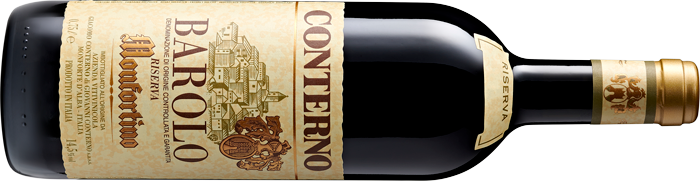
Giacomo Conterno produced the first recognised vintage in 1924, at a time when much Barolo was still sold in cask or demijohn. The name refers to Monforte d’Alba, where the Conterno family’s business began, although the wine’s modern identity is closely associated with estate-owned vineyards in Serralunga d’Alba.
Monfortino is made only when the estate believes the fruit warrants the name. Nebbiolo undergoes a long, traditional fermentation and extended skin contact, historically without tight temperature control. The wine then spends around six or seven years in large oak botti. New barriques, fashionable shortcuts and rushed releases have no place here.
The result can appear severe when young. Monfortino is built around acidity, tannin and aromatic detail rather than immediate sweetness. With time, that formidable structure opens into the roses, tar, dried cherry, spice and earthy complexity for which mature Barolo is celebrated.
Production is especially difficult to summarise because the wine is not made every year and the quantity depends on how much fruit Roberto Conterno selects for it. In 2013, when the entire Francia Barolo production was directed into Monfortino, approximately 20,000 standard bottles, 2,500 magnums and 400 three-litre bottles were made. Other releases have been substantially smaller.
The key fact is not simply that Monfortino is rare. It is that Conterno is prepared to have no Monfortino at all rather than produce one that falls short. In an industry built around annual releases, that willingness to leave a space in the catalogue carries considerable weight.
6. Solaia, Marchesi Antinori
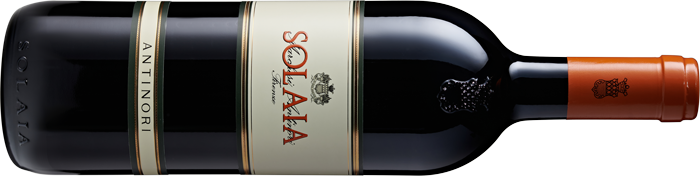
Tignanello and Solaia come from the same Antinori estate, but they are not variations on the same theme.
Tignanello places Sangiovese at the centre of the conversation. Solaia gives Cabernet the leading role. The wine comes from a 20-hectare, south-west-facing vineyard between 350 and 400 metres above sea level, with rocky alberese limestone and galestro soils.
The first Solaia was produced in 1978 using 80 per cent Cabernet Sauvignon and 20 per cent Cabernet Franc. Sangiovese was introduced later, eventually settling at around one-fifth of the blend, although the exact composition changes with the vintage. The wine has not always been produced. Antinori omitted the 1980, 1981, 1983, 1984 and 1992 vintages after deciding the harvest did not meet the required standard.
Selection is uncompromising. Grapes are destemmed, sorted berry by berry and transferred by gravity into small, truncated conical fermentation tanks. Malolactic fermentation takes place in barriques. The 2022 matured for approximately 15 months in new French oak, with the varieties aged separately before blending and returning to barrel.
Average production is usually estimated at between 60,000 and 65,000 bottles. It therefore occupies a useful middle ground in the Antinori hierarchy: far scarcer than Tignanello, but produced in greater quantities than the smallest cult wines of Tuscany and Piedmont.
Solaia is sometimes described as Tignanello’s more glamorous sibling, but that undersells its character. It can certainly be richer and more Cabernet-driven, yet the inclusion of Sangiovese gives the wine acidity and a recognisably Tuscan edge. The two wines share a hillside, not an identity.
7. Case Basse, Gianfranco Soldera
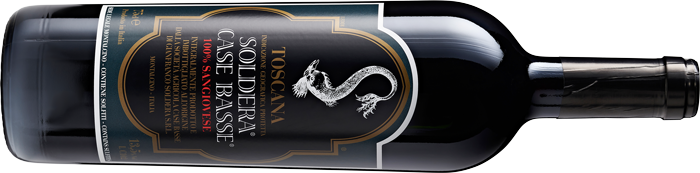
Case Basse is one of the clearest expressions of Gianfranco Soldera’s conviction that great wine should be grown, observed and guided rather than engineered.
Soldera and his wife, Graziella, began building the estate in Montalcino during the 1970s. The property covers approximately 23 hectares, with around ten hectares under vine. Its only red grape is Sangiovese, cultivated and selected with extraordinary severity.
Harvesting and selection are carried out by hand, down to individual berries. Fermentation occurs spontaneously in large, upright Slavonian oak vats using the microorganisms naturally present in the cellar and on the fruit. Artificial yeasts are not employed. Temperature and microbiological activity are nevertheless monitored closely, combining traditional instincts with detailed scientific analysis.
Ageing takes place in large Slavonian oak barrels in a cellar built 14 metres underground. The cellar was constructed from natural materials without concrete, using natural airflow to maintain a temperature of around 13°C and high but stable humidity. Bottling is completed within the cellar to minimise movement and changes in environmental conditions.
Soldera stated that the estate produced an average of 15,000 bottles a year, with volumes cut further when a vintage failed to meet expectations. The 2021 release consisted of 19,166 standard bottles and 1,522 magnums, all individually numbered. By comparison, the 2017 yielded only 11,149 standard bottles.
The wine was once sold as Brunello di Montalcino Riserva but is now released as Toscana IGP Soldera Case Basse. The change in classification has done nothing to lessen demand. Collectors are buying Soldera, not an appellation name.
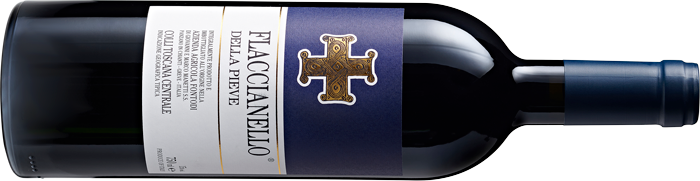
8. Flaccianello della Pieve, Fontodi
Flaccianello della Pieve proves that a wine does not need Cabernet, coastal glamour or regulatory controversy to become a Tuscan icon.
Fontodi is based in Panzano, in the heart of Chianti Classico. The Manetti family acquired the estate in 1968, having spent centuries working in the region’s terracotta industry. That background offers an appropriate connection to the earth, although the modern estate is known for certified organic farming and a gravity-fed cellar rather than decorative pottery.
Flaccianello is made entirely from Sangiovese selected from Fontodi’s best vineyards. Fermentation and maceration take place in stainless-steel tanks with indigenous yeasts for at least three weeks. The wine then matures for 24 months in a combination of French oak barrels and larger casks.
Earlier vintages were more closely associated with a single vineyard, but Flaccianello has developed into a selection of the estate’s finest Sangiovese parcels. That gives the winemaking team greater freedom to preserve the wine’s identity as weather conditions change from one vintage to another.
Average production is approximately 60,000 bottles. This is limited enough to maintain scarcity, but large enough for Flaccianello to have developed a broad international following.
Stylistically, it sits in an attractive position between old and new Tuscany. There is concentration and French oak, but also the sour cherry, herbs, acidity and savoury bite that make Sangiovese unmistakable. It is a serious wine without the need to dress itself in borrowed Bordeaux clothes.
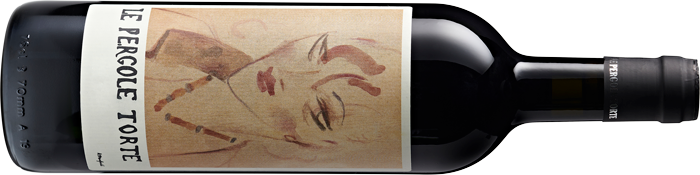
9. Le Pergole Torte, Montevertine
Montevertine’s relationship with the Chianti Classico rulebook could politely be described as strained.
The estate was founded at Radda in Chianti, where Sergio Manetti initially made wine as a hobby. Le Pergole Torte first appeared with the 1977 vintage and was one of the first prestigious wines from the area made solely from Sangiovese.
Montevertine eventually withdrew from the Chianti Classico denomination rather than follow the blending rules of the time, which required the use of white grapes. The estate chose to sell its wines under humbler classifications while continuing to make them as it wished. It was a principled decision that history has treated kindly.
Le Pergole Torte is fermented for around 25 days in concrete vats, where malolactic fermentation also takes place. It then spends 12 months in Allier oak barriques and another 12 months in large Slavonian oak casks, followed by a short period in bottle before release.
Production generally reaches no more than about 30,000 bottles. Even at that level, allocations are keenly contested and much of the wine is committed before release.
Its labels are almost as recognisable as the wine. The late artist Alberto Manfredi created a succession of female portraits for Le Pergole Torte, giving each vintage its own face while maintaining a visual identity stretching across decades.
The wine itself is less flamboyant than the artwork. Le Pergole Torte is admired for perfume, tension and fine-grained structure rather than brute force. It is one of Tuscany’s strongest arguments that pure Sangiovese, handled with patience, requires no supporting cast.
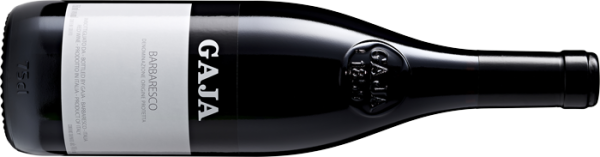
10. Barbaresco, Gaja
Gaja’s Barbaresco is sometimes overshadowed by the estate’s famous single-vineyard wines. That would have irritated Angelo Gaja, who has spent years insisting that the flagship blend should never be treated as the basic bottle.
The Gaja family established its winery in Barbaresco in 1859. Angelo Gaja joined the business in 1961 and became one of the most influential figures in modern Italian wine, introducing lower yields, temperature control, French oak and a more rigorous focus on individual vineyard character.
The estate’s classic Barbaresco is 100 per cent Nebbiolo, blended from 14 vineyards within the denomination. This is not a leftover selection. Combining sites allows Gaja to build a complete picture of Barbaresco, balancing perfume, tannin, depth and freshness across several different exposures and soils.
The wine typically spends three to four weeks on its skins. It then matures for around a year in French oak barriques, only a modest proportion of which are new, followed by a second year in large traditional botti. The result joins modern precision to the long élevage and firm structure expected of serious Nebbiolo.
Published historical estimates have placed production at roughly 11,000 cases, equivalent to around 130,000 bottles, although Gaja does not publish a fixed contemporary figure and output will move with the vintage.
A small piece of branding trivia sits in plain sight. The large GAJA lettering appeared on the family’s labels in 1937, decades before oversized producer names became a luxury marketing habit. Today it remains one of the most instantly recognisable labels in Italian wine.
Ten wines, ten different definitions of greatness
These wines do not share a single recipe for success.
Sassicaia and Tignanello became famous by challenging the rules. Soldera and Montevertine built their reputations by refusing to compromise. Masseto found greatness in one peculiar hill of blue clay. Monfortino relies on selection and time in quantities that make little commercial sense. Gaja combined new ideas with a determination to raise the international standing of an entire region.
Production ranges from hundreds of thousands of bottles to releases small enough to disappear into private cellars almost immediately. Some depend on French oak and international varieties. Others are devoted to Sangiovese or Nebbiolo and traditions refined over generations.
The common thread is not rarity, price or critic scores. It is identity. Each bottle tastes as though it could have come from nowhere else and been made by nobody else.
Search figures can tell us which names command the world’s attention. These ten wines explain why they have kept it.