Uncorked: Episode 8 - Mulled Minds
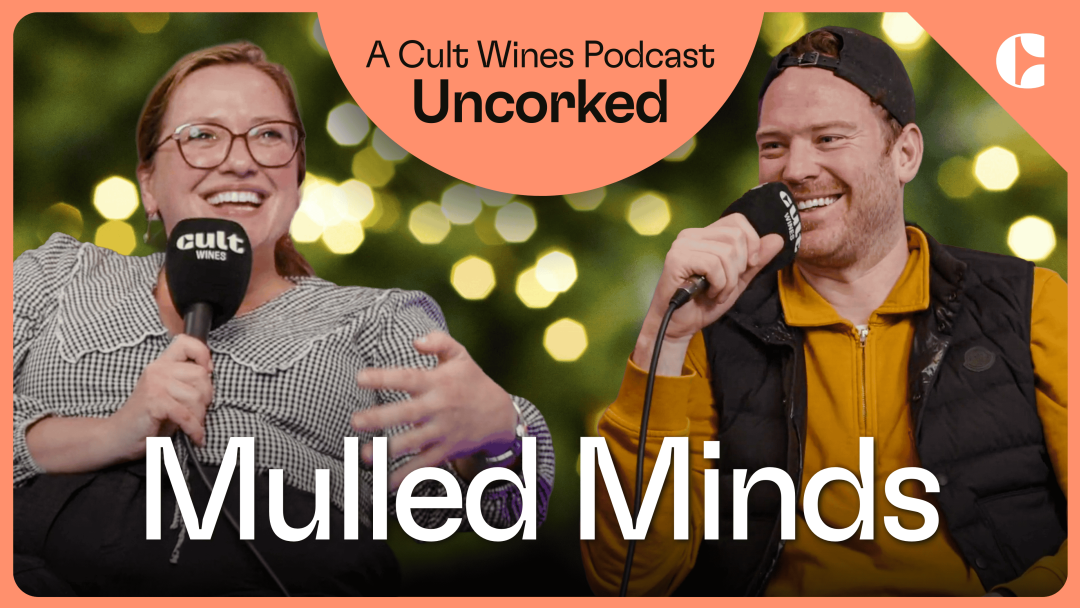
Welcome to Episode 8 of Uncorked, the Cult Wines podcast, and our final show of 2025.
Tom Gearing, Cult Wines’ Co-founder and CEO, is joined by Jonathan Stevenson, EVP of Cult Wines North America, with special guest Victoria Daskal.
Victoria is a wine writer, educator, WSET instructor and global traveller whose tastings and experiences bring history, culture and people together. We wrap the year with a lively conversation about how people discover wine, how learning turns curiosity into confidence, and why stories and place make the journey stick.
We are closing 2025 on a high and looking ahead to 2026 with real excitement.
Watch/Listen Now
What topics were covered?
How Victoria found her spark
Victoria’s spark was a single glass that opened a door. As a student in Montreal, a Penfolds wine caught her attention with vivid aroma and flavour, and set her on a path to learn, taste and travel. Courses in Boston followed, guided by a mentor who framed wine through history and culture rather than rules. Time in France deepened the picture, from vineyard work to selling along the Côte d’Azur. Early writing and careful editing with Jancis Robinson helped sharpen a clear, balanced voice.
From there, the discussion widens to how people find their way into wine. Victoria champions approachable education, tasting groups and curiosity over jargon. Study gives you language for what you taste, while travel and context make the lessons memorable. The result is not a checklist but a way to connect wine to people, places and moments.
Natural, organic & biodynamic
The trio unpack where farming meets philosophy. Biodynamics is framed as vineyard-first, often quietly practised for healthier soils, while natural wine is discussed as low-intervention winemaking with a lively scene that draws in new drinkers. Names and places come up, from Loire, Savoie, Jura and Beaujolais to Austria’s Burgenland and the Pannobile group, with Judith Beck highlighted as an accessible way in. The team also touch on collectors’ favourites where these worlds meet, and why some of those bottles now trade at serious levels.
Closures, ageing & pairings
A fast, fun segment puts common wine beliefs to the test. Jonathan reads a series of statements for the team to call FACT or MYTH. No sitting on the fence and no spoilers here, so you can play along as you listen.
The statements on the slate:
- “Screw caps mean cheap wine.”
The team explore why closures are chosen, how oxygen management works, and what top producers are doing under cap. - “All wine gets better with age.”
Expect a chat about structure, style, vintage, provenance and format, plus when evolution becomes decline. - “You can’t pair red wine with fish.”
The nuances of tannin, texture and cooking method come into play, along with a few smart exceptions. - “Champagne must be expensive to be good.”
The team weigh non-vintage quality, grower versus house styles, and where value shows up on the shelf. - “Organic wine means no sulphites.”
Labelling, legal limits and cellar practice get unpacked, including what “no added” really means.
Each call comes with a clear rationale, but the verdicts are saved for the episode.
A bottle to remember
Victoria pours a Spanish red to taste blind. It turns out to be an old-vine field blend from Ribera del Duero, grown around 900 metres and made in tiny quantities, with Tempranillo, Bobal and even a touch of white varieties in the mix. The style is bright, spicy and lifted, showing how altitude and gentle élevage can reshape expectations.
Wine, music & literature
Experiences matter. Victoria recalls tastings that paired fine wine with the London Symphony Orchestra and others that mapped Hemingway’s Paris onto a glass by reading passages and pouring Sancerre, Chablis and Burgundies that echo the book. It is wine as part of culture, not homework.
Final thoughts
Today’s chat wasn’t really about corks, scores or who called what in the game. It was about how people learn, how we disagree without getting precious, and how a glass in the right moment can change the way you see everything. We heard why teaching works best when it starts with stories. We heard that travel keeps you honest. We heard that labels help, but people and places do the heavy lifting.
A few realities landed, too. Price is not the same thing as pleasure. Farming choices matter, but they do not need a spotlight to be meaningful. Closures carry trade-offs, and the smart move is to know which trade-off you are choosing. Age is only a gift if the bottle was good to begin with and kept well. Food pairing is not a rulebook. It is a conversation between texture, weight and intent.
So here is the takeaway as we close the year. Be curious. Ask why a wine tastes the way it does. Taste with friends who challenge you. Keep something in the cellar you are not ready to open. Keep something you cannot wait to open. And when a myth shows up dressed as a fact, give it a gentle nudge and taste again.
Thank you for listening, watching and for writing in. That is Episode 8, and that is 2025. We cannot wait to bring more conversation, bottles and ideas to you all in 2026.
👉 Subscribe for more Uncorked episodes and fine wine insights every month.