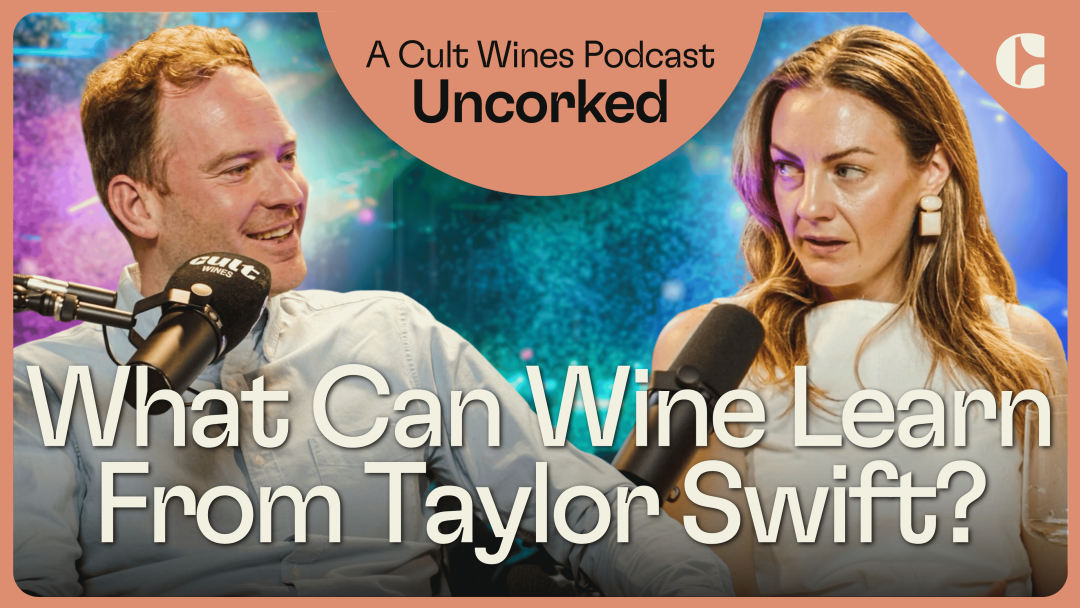
Uncorked: Episode 15 - What Can Wine Learn From Taylor Swift?
Welcome to Episode 15 of Uncorked, the Cult Wines podcast. Tom Gearing, our Co-founder and CEO, is joined by Jonathan Stevenson, EVP of Cult Wines North America, and special guest Sinéad O’Sullivan.
This episode moves from wine to strategy, spaceflight, Taylor Swift, culture, collecting and back again. It asks what the fine wine world can learn from one of the most successful modern brand builders on the planet, and why experience, community, storytelling and ownership matter more than ever.
From Burgundy’s legacy systems to rebel winemakers, wine as a lifestyle, and whether Spain could be the region to pull off a power move over the next decade, this is a wide-ranging conversation with plenty of sharp turns. And, as ever, there is room for a bit of fun between the bigger questions.
Watch/Listen Now
What topics were covered?
Meet Sinéad O’Sullivan
Sinéad O’Sullivan is not exactly short on interesting chapters. She began her career as an aerospace engineer and human spaceflight designer, working with NASA and its Jet Propulsion Laboratory, before moving into strategy, economics and investment.
She has an MBA, previously led strategy at Harvard Business School’s Institute for Strategy and Competitiveness, and co-founded a global investment fund. She also writes for titles including the Financial Times, Vogue, Noble Rot and The Currency, holds her WSET Level 3, and is, by her own verified Spotify data, in the top 0.01% of Taylor Swift fans.
Her 2025 book, Good Ideas and Power Moves, looks at Taylor Swift not simply as a musician, but as a serious strategist, brand builder and business operator. As Tom puts it, Sinéad’s CV reads like three people’s, which makes her a natural guest for an episode that refuses to stay in one lane for very long.
From NASA to Wine
Sinéad’s way into wine was not through a single life-changing bottle. It was through people. During lockdown, while studying for WSET, she met Colin McCann at Ballymaloe in Ireland, who helped her revise for her exam and, more importantly, made the wine world feel open rather than intimidating.
That becomes one of the early themes of the episode. Wine can often feel like an inside-outside culture, with codes, language and access points that are not always obvious from the outside. Sinéad’s experience was different. She met someone whose enthusiasm made her feel like an insider without judging her for being new to it.
The conversation touches on mentorship, obsession and the people who make wine feel alive. For Sinéad, the appeal of wine sits as much in the people and places around the bottle as in the bottle itself.
Obsession, Outsiders & Interesting Problems
Tom and Jonathan dig into the unusual thread that runs through Sinéad’s career, from spaceflight and strategy to wine writing and Taylor Swift. Her answer is simple: she is drawn to people who are completely obsessed with solving interesting problems.
That same curiosity took her from human spaceflight design to strategy, geopolitics, culinary school, wine study and book writing. There is also a memorable detour into working in the pastry section of a two-star restaurant, and the realisation that cooking in a professional kitchen does not automatically mean you can casually host a flawless dinner party at home.
It is a useful setup for the rest of the episode, because Sinéad approaches wine with the same strategic lens she applies to business, music and culture.
Taylor Swift as CEO
The heart of the episode is Sinéad’s argument that Taylor Swift should be understood as one of the sharpest CEOs and strategists working today. Her book began as a more traditional project about hedge funds, but a chapter on Swift made the bigger point too clear to ignore.
Sinéad explains that the business world was slow to understand what Swift had really built. Many people thought the valuable asset was the catalogue. Sinéad argues that the real asset was the fan base, and that this community was portable, loyal and powerful enough to reshape the economics around her work.
That leads into a wider discussion about ownership, the re-recordings, Taylor’s Versions, and why the music industry underestimated the force of a deeply engaged community. It is not just pop culture chat. It is a strategic case study in power, distribution, brand control and how an outsider can change the rules of a market.
What Wine Can Learn from Swift
The Taylor Swift comparison becomes especially interesting when the conversation turns back to wine. Sinéad talks about Swift as both the product and the CEO of the product, with control over branding, community, distribution and supply.
That opens up a bigger question for fine wine: who is building worlds, and who is still relying on old systems to do the work for them? The group discuss how younger consumers, digital culture, social media and changing expectations have made it harder for wine to wait behind the cellar door and assume people will come looking.
The point is not that wine should become music. It is that wine, like music, art and culture, is an emotional and experiential category. If producers and businesses want to stay relevant, they need to think beyond the bottle as a product and consider the community, story and lifestyle around it.
Anti-fragility & the Regions that Can Move
Sinéad brings in the idea of anti-fragility, a term often used in hedge funds. Resilience means getting knocked down and standing back up. Anti-fragility means getting stronger because of the shock.
That leads to a lively discussion about whether parts of the wine world are flexible enough to adapt to climate, changing consumer behaviour and power shifts. France, AOCs and legacy systems come under scrutiny, with Tom and Jonathan adding nuance around the different regions and the role classification can still play in quality.
Burgundy, Champagne and Bordeaux are discussed in different lights, while Tom brings up Pierre Vincent Girardin as an example of a younger producer experimenting outside the expected frame. The point is not that tradition has no value. It is that, in a changing market, the ability to move may matter just as much as the weight of history.
Rebel Wine & Decentralised Quality
One of Sinéad’s strongest ideas is that the future may belong, at least in part, to “rebel wine”. She is interested in producers who are building names, lifestyles and followings that are not entirely dependent on centralised quality markers.
That includes younger winemakers, new regions and people who are creating interest beyond appellation or classification alone. The bottle still matters, of course, but so does the person behind it, the food they eat, the world they build, and the way drinkers feel connected to them.
Jonathan connects this to a wider issue in wine: the distance between seeing a bottle on a shelf and feeling close to the person who made it. Bridging that gap may be one of the biggest opportunities for producers who want to reach the next generation.
Wine as Merch, Lifestyle & Experience
The conversation then turns to experience. Sinéad compares the shift in music, where the recording has become less of the direct revenue driver and live experience has become central, with what could happen in wine.
A story about a bottle from Donum Estate that a friend had brought back leads into a discussion about art and lifestyle, sparked by a William Kentridge piece connected to the estate, and how a bottle can become part of a much wider experience. Sinéad describes the bottle as "merch" in that context, not because the wine was unimportant, but because it carried the memory and meaning of the visit.
Tom pushes back with one of wine's most important differences: it cannot be consumed digitally. A great bottle also has an analogue magic, especially when age, provenance and time are part of the story. The group lands on the idea that wine needs both the physical romance of the bottle and the modern tools that help more people find their way into that world.
Insiders, Outsiders & Who Gets Let In
Another big theme is access. Sinéad points out that Taylor Swift can scale to millions of fans without degrading the value of the product, while wine has the opposite challenge. Scarcity is part of what makes collectible wine valuable, but scarcity also creates insiders and outsiders.
The group discuss how wine might bring more people in without losing the mystique that makes it special. Jay-Z, Cristal, Ace of Spades, Sancerre, 19 Crimes, Snoop Dogg, Penfolds and LVMH all come into the conversation as examples of how music, lifestyle and wine can collide, sometimes brilliantly and sometimes awkwardly.
It raises an uncomfortable question for the wine world: when culture knocks on the door, does wine open it quickly enough?
Heritage Versus Change
Tom compares the challenge in wine to heritage brands in other categories, including cars. How do you modernise without alienating the people who built the brand’s status in the first place?
That question feels especially relevant for classified Bordeaux growths, top Champagne houses and other producers whose reputations rely heavily on legacy. Tom, Jonathan and Sinéad explore the balance between protecting heritage and embracing the future, while also asking whether newer producers have more freedom to take risks because they are not carrying the same weight of expectation.
It is one of the more strategic parts of the episode, and one that will resonate with anyone thinking about how fine wine brands can stay culturally relevant without flattening what makes them distinctive.
The Eras Cellar
Of course, an episode with Sinéad was never going to escape without a Taylor Swift wine game. Jonathan introduces The Eras Cellar, asking Sinéad to pair different Taylor eras with a wine, region or style.
Sinéad gives it her own spin, answering through what she was drinking during those parts of her life. Fearless takes us to Buckfast, Reputation to Château Margaux, Red to Riesling in Strasbourg, Folklore and Evermore to a lockdown gin era, 1989 to wine flights in New York, and The Tortured Poets Department to Sassicaia.
As Jonathan sums it up, it is quite the journey: from Buckfast to Sassicaia.
Bordeaux Fires, SpaceX & One Final Power Move
The episode also briefly touches on the serious news around wildfires in Europe and Bordeaux. Jonathan notes that, at the time of recording, the fires did not appear to be affecting the vines, but keeps the focus where it belongs, on the people affected and the first responders on the ground.
There is also just enough time for a bonus space question, because no one was going to let a former human spaceflight designer leave without talking about SpaceX. Sinéad gives a sharp read on the company’s shift from a Mars-focused mission to a broader frontier technology story, with Starlink, Starship and some big structural questions in the mix.
Finally, Jonathan asks which wine region or producer could pull off a Taylor-scale power move over the next decade. Sinéad picks Spain, citing its organisation, growing confidence and exciting producers. The conversation brings in Vega Sicilia, Unico, Rioja, Comando G, Palacios, Godello, Albariño and sherry, with the group agreeing that Spain has serious untapped potential.
This episode covers a lot of ground, from wine to business, strategy, music, space and the strange power of fandom. Pour something interesting, choose your era, and settle in. Follow the podcast, send us your questions, and tell us which wine region you think is ready for its power move.
👉 Subscribe for more Uncorked episodes and fine wine insights every month.
Join the Cult Wines podcast discussion on Reddit and share your thoughts on this episode.