One Hillside, Four Minds: A Week with Burgundy's Quiet Masters

Drive the length of the Côte d'Or on the old RN74, and the famous names arrive one after another on small brown signs: Gevrey, Morey, Chambolle, Vougeot, Vosne, Nuits.
Each marks a village you could walk across in ten minutes and a hierarchy of vineyards that has taken eight hundred years to settle. I spent a week visiting four domaines along that road, expecting variations on a shared theme.
What I found instead were four people taking completely contradictory routes to the same destination, the truest possible expression of a single patch of ground, each so committed to their own approach that the others' barely seemed to register.
That tension is the real story of Burgundy, and you only see it up close. Here is how four of them answered the same question over the course of one week.
Grivot: The Red Line
In Vosne-Romanée, the village holds Romanée-Conti, La Tâche and Richebourg within a few hundred metres of one another and shows you almost none of it. From the road, there is a church, a war memorial, and tractors parked in courtyards. The grandeur is all underground.
What sets Domaine Jean Grivot apart begins before the wine. Etienne Grivot keeps a shop, Villa Velle, stocked with older releases, which means you can taste the domaine across a decade in one sitting rather than guessing at the past from a single young vintage.
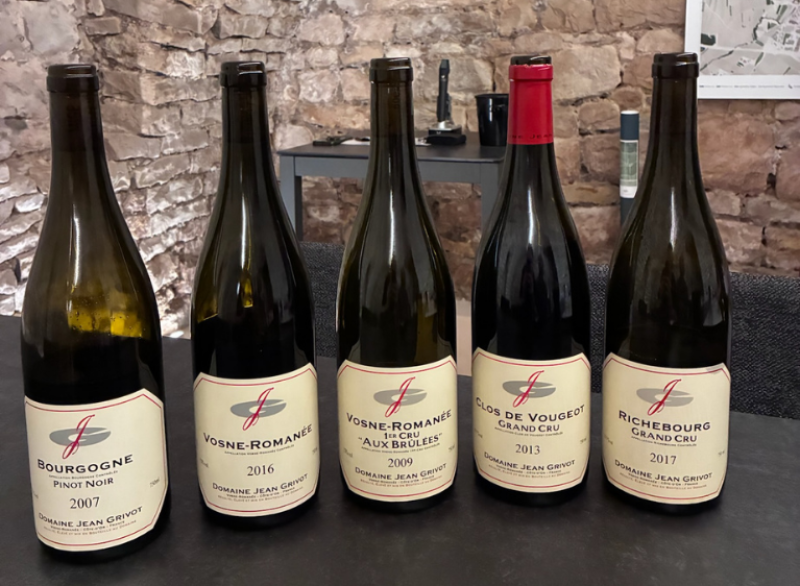
That is rarer than it sounds, and it changes what a visit can prove. With Mia Cerutti, the domaine's host, I worked through eighteen years in a morning: Bourgogne 2007, Vosne-Romanée 2016, Aux Brûlées 2009, Clos de Vougeot 2013, Richebourg 2017.
Ask Mia what makes a great winemaker, and she answers before you finish the question: consistency. She calls it fil rouge, the red line, the idea that should run through every wine a producer makes, warm vintage or cool.
A great winemaker, she said, minimises the influence of the vintage without ever denying its character, so the estate's signature stays evident even in the hardest years. You can hear the conviction in how flatly she says it. The cellar backs her up.
The same recipe runs from the humble Bourgogne to the Richebourg, fully destemmed, no crushing, a gentle twenty-day fermentation opening with a five-day cold soak, fifteen months in barrel, bottled unfiltered in March, new oak held at 30% and split across four coopers so no single barrel ever stamps itself on the wine. Nothing is allowed to separate one wine from another. Whatever ends up in the glass comes from the soil and the season alone.
And it does. The Aux Brûlées 2009 had a wild, almost barnyard edge, the fingerprint of a plot that a fold in the hill, the Concoeur combe, cools by a fraction of a degree; in cooler decades it struggled to ripen, which is why it never made Grand Cru, and in a warming one that same coolness has become its gift. The Clos de Vougeot 2013 was elegant, where the appellation is famous for muscle.
Then the Richebourg 2017, barely a thousand bottles in an ordinary year, lifted and pure with a current of acidity carrying it across the palate. I have tasted a lot of Richebourg, and I went quiet for a moment over that glass. Most domaines ask you to take their philosophy on trust. Grivot pulls the cork on eighteen years and lets the consistency settle the argument.
Marchand-Tawse: Doing Nothing the Same
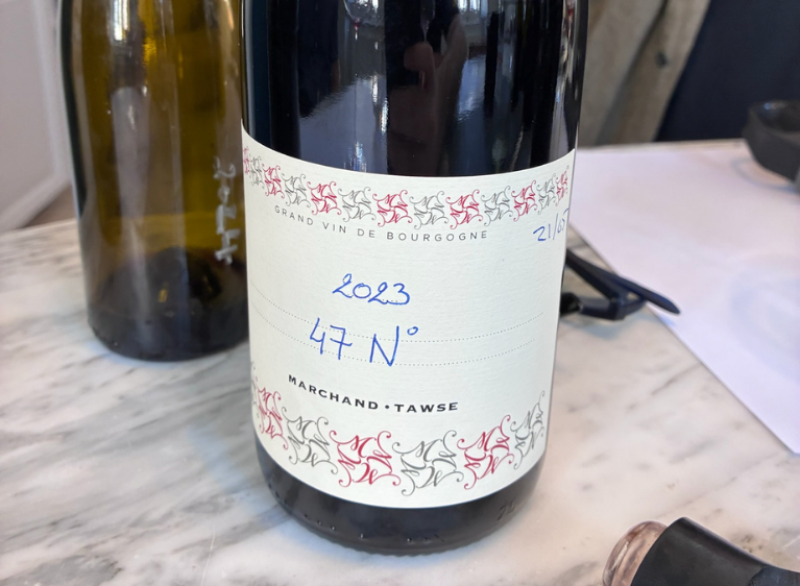
I had blocked out an hour with Pascal Marchand. We tasted for three. Every time I thought we were finishing, he would disappear back into the cellar and return with another bottle and another story, about his neighbours, the Burgundy of the 1980s, his sons, and somewhere in the blur of nearly thirty wines, I gave up on the schedule entirely.
A few minutes' drive south of Vosne, in the working town of Nuits-Saint-Georges, I had walked straight from the most disciplined domaine of the week into its opposite.
If Grivot is a straight line held for fifty years, Pascal is a firework that has been going off for forty-three. His creed is a line he tossed off between barrels: “We do nothing the same. We like to have fun here.”
Where Grivot fixes the method and lets the terroir talk, Pascal changes everything. Whole-cluster percentage is decided at the sorting table on the look of the grapes, never a recipe. New oak runs from nothing on the regional wines to 100% on certain Grand Crus. Two cuvées see no sulphur at all. He shrugged it off as instinct: “We adapt to the year, to the vineyards, to what we think, to what we feel.”
It would sound like chaos to anyone without the background, and this is one of Burgundy's strangest.
A Montreal-born former merchant marine and poet, he arrived in 1983 with no experience in wine, and by 1985, aged twenty-nine, was running Domaine du Comte Armand in Pommard, only the second non-Frenchman ever to head a Burgundian estate.
He belonged to the golden mid-1980s generation that took the reins together, Lafon, Roumier, Grivot, de Montille, and counts Henri Jayer among his mentors. He built Domaine de la Vougeraie for the Boisset family, then went out on his own, and since 2009 has worked alongside the Canadian financier Moray Tawse.
The numbers alone make your head spin: ten hectares farmed across twenty-one appellations, fruit bought for thirty more, often a single barrel at a time, around fifty wines a vintage, some down to a single half-barrel of Musigny in 2024. And yet for all the restlessness, what comes through in the glass is restraint.
“The winemaking is more and more doing less,” he said, letting the polyphenols come out gently so the tannins arrive finer, and the wines prove it, transparent and silky, and each one its own creature. That was the thing I drove away, turning over. I had expected so much improvisation to show up as inconsistency, and instead, every wine was unmistakably his.
Nothing Pascal does is ever the same, and somehow that is the signature.
Dujac: One Idea, Followed All the Way Down
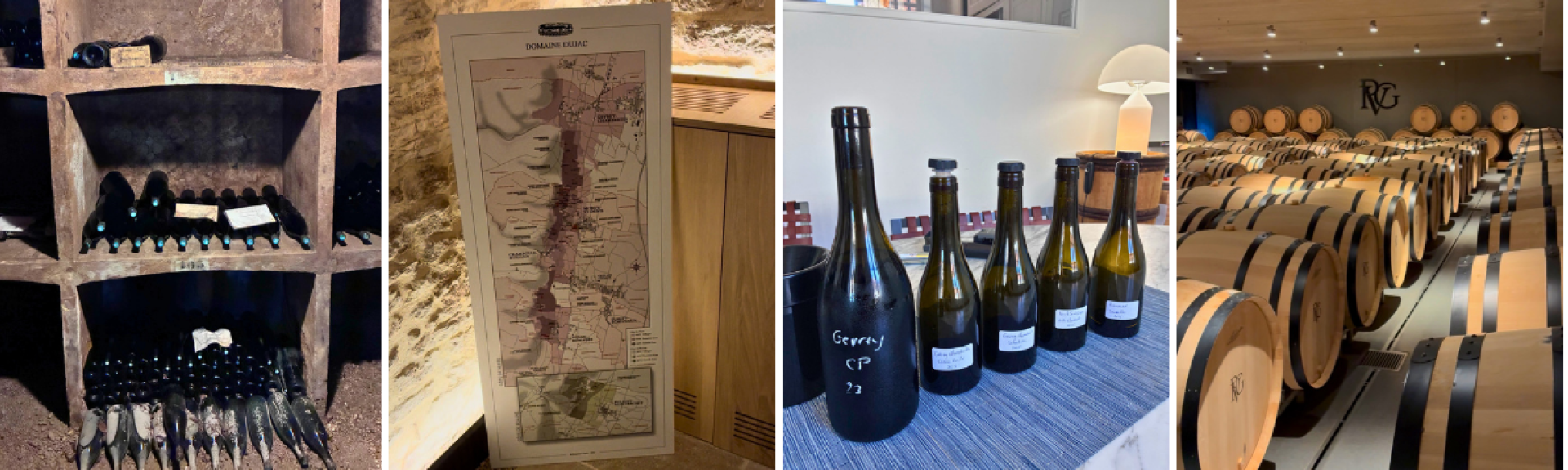
Alec Seysses kept coming back to a single word, and by the end of the morning, I was hearing it in every glass: tannin.
I had driven back north to Morey-Saint-Denis, the quiet village between Gevrey and Chambolle that most people pass through on the way to somewhere more famous. Where Marchand had been a flood, the morning at Domaine Dujac was a single deep channel.
Founded by Jacques Seysses in 1968 and now led by his sons Jeremy and Alec, the domaine has spent half a century building one of the Côte de Nuits' most distinctive voices, all of it on whole-bunch fermentation: across every red, the stems are there, a thread of spice and lift from the village wines to the Grand Crus. But tannin was the lens through which Alec read everything: vintage, terroir, ageing, and his own choices in the cellar.
The 2024s, he explained, carry tannins that are present but not as large as 2022 or 2023, with more acidity behind them, and that is exactly what gives the vintage its finesse and tension. Lighter than the big years, he said, but not light. I have sat through a lot of tastings, and I can't remember another winemaker explaining his whole worldview through a single structural component and making it so convincing.
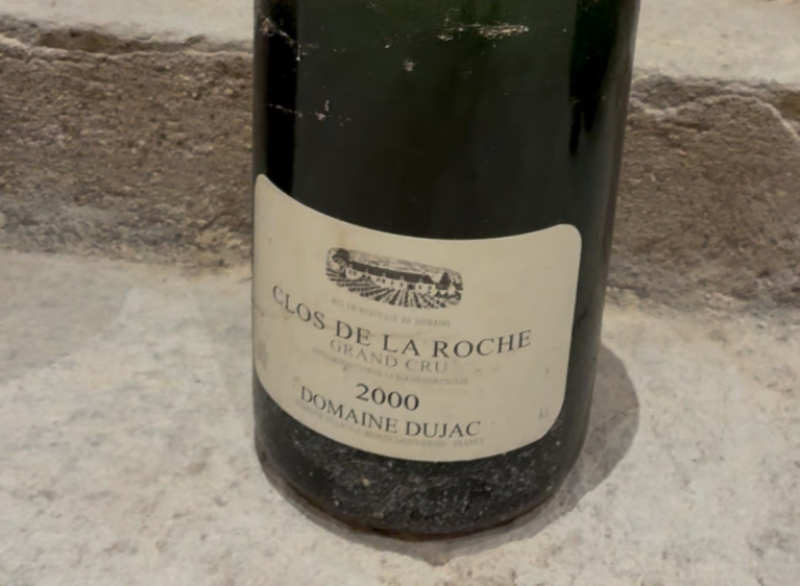
The lesson landed when he poured Clos de la Roche and Clos Saint-Denis side by side, both Grand Cru, both 2024, both unmistakably Dujac, and asked me to find the difference before he explained it. Clos de la Roche runs from the clay-heavy bottom of the slope to the limestone top, and the wine marries the two: bright fruit, real density, elegant with it.
Clos Saint-Denis is almost entirely upper-slope, where a break in the hillside funnels cold air across the vines and lends a fraction of a degree of coolness that surfaces years later as lift and delicacy. It was the more ethereal of the pair, red-fruited and floral with a long savoury finish, and the wine I was still thinking about that evening.
We finished blind, as Dujac likes to, with a Bonnes Mares 1996, fully tertiary, its tannins softened completely, exactly as Alec had described a wine that has finally digested its own structure. His father always said you should make wine for drinking, not for tasting, and you feel that everywhere here: wines built to come alive over a long meal rather than impress in a flight.
Drink the wines, then drink them again in ten years, and you understand why people talk about Dujac the way they do.
Pierre-Vincent Girardin: The Science of White
The juice in the barrel looked like dirty oil. That was the image I left Meursault with, and it took some explaining.
This was the last visit, and it meant leaving the Côte de Nuits behind and driving south through Beaune into white-wine country, where after three days of Pinot Noir the prospect of Chardonnay felt like a change of language. Some winemakers talk about wine.
Pierre-Vincent Girardin talks about systems. In a generation of hugely talented young Burgundians, PVG has built a reputation for some of the most distinctive, ageable whites coming out of Meursault, searing acidity, a flinty reductive edge, a backbone that holds for decades, and tasting the full 2024 range felt less like a tasting than a look inside a mind working differently from everyone around it.
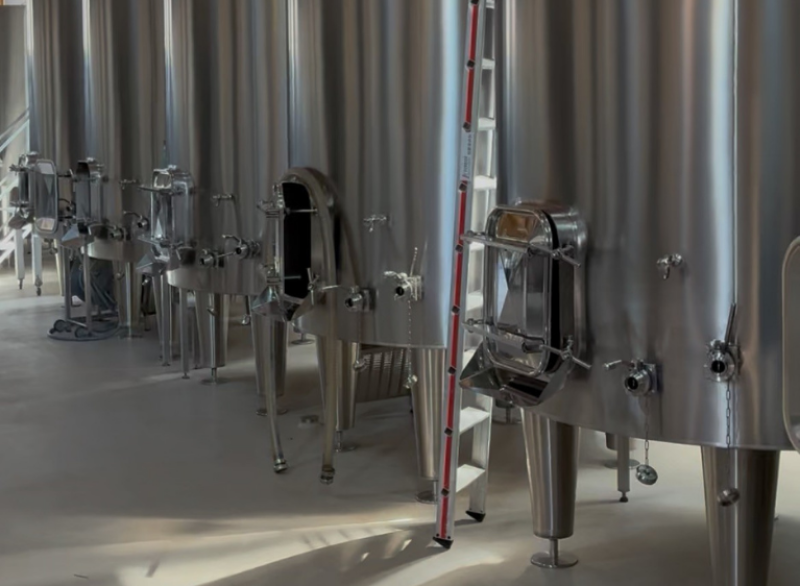
His one word is reduction, and the whole cellar is built around it: sealed tanks, nitrogen at every transfer, a minimum of two years on lees so the wine keeps feeding and protecting itself. “I want my whites to be more tannic than my reds,” he said, and one mouthful of the Perrières tells you he means it.
The dirty-oil moment is where it starts. Before any of that protection begins, he deliberately lets the must oxidise hard, until the juice turns dark and ugly, then lets fermentation clean it up and bring the wine back bright. “All the bad things that could happen need to happen first,” he said. “Then we have clean wine, and wine that protects itself.”
It is the precise inverse of how most white Burgundy is made, where the whole game is keeping oxygen away from the juice, and I stood there genuinely unsettled by it until the wines made the case he couldn't quite put into words.
The rest follows the same logic of control: every vintage, a clean page; 100% new oak; indigenous yeast only; around forty wines, each fermented in a tank sized exactly to its plot; almost no blending, because, for him, the differences between the plots are the entire point.
And he is still pushing, with Savagnin planted on a forested hilltop in Pommard, a “lab” vineyard of fifty rows across five rootstocks, and a seven-year solera experiment in the Jura to learn how long lees stay alive. The climate is changing, he said, the work is getting harder, and the only answer is to understand nature rather than fight it.
I left thinking I had watched one possible future of white Burgundy being built in real time.
The Drive Home
I drove home with four contradictions in my head and no way to reconcile them, which turned out to be the point. Grivot removes himself and trusts the soil. Marchand trusts instinct and changes with every vintage. Dujac follows a single idea all the way down. Girardin engineers nature into submission and somehow makes it sing. Lay their methods side by side, and they argue with each other, yet each one makes wine that could only have come from exactly where it was grown.
What stayed with me was not any single bottle, remarkable as that Richebourg and that Clos Saint-Denis were. It was how certain each of them was, and how little that certainty resembled the next person's. I had gone looking for the thing the best producers quietly agree on, the technique, the formula underneath it all, and there isn't one.
There is only conviction: the willingness to back a single idea completely and live with whatever the wine says in return. You can buy these bottles anywhere in the world. But you only really understand them once you have sat across a barrel from the person who made them and heard, in their own words, why they do it their way and not the way of the village next door.
Related Articles
A Journey Through Burgundy: Four days on the Côte d’Or
By Tom Turner
Georgia: The Ancient Homeland of Wine
By Jessie Wu