A Journey Through Burgundy: Four days on the Côte d’Or

There is a particular quiet that settles over the Côte d’Or in early July. The vines stand in full leaf, the grand cru slopes lie heavy and green in the morning light, and the villages, names that read like a rollcall of the sublime, go about their business as though the most coveted wines on earth were not being raised in the fields at the edge of town.
It was into this landscape, over four midsummer days, that we brought a small party of clients: three couples, travelling from England, Dubai and China, united by a shared curiosity about wines they had so often admired from afar. Our purpose was not to taste in the abstract, but to walk the vineyards, sit at the tables of the people who tend them, and to understand, glass in hand, on the ground itself, why a few hundred metres of Burgundian limestone can hold such a grip on the imagination.
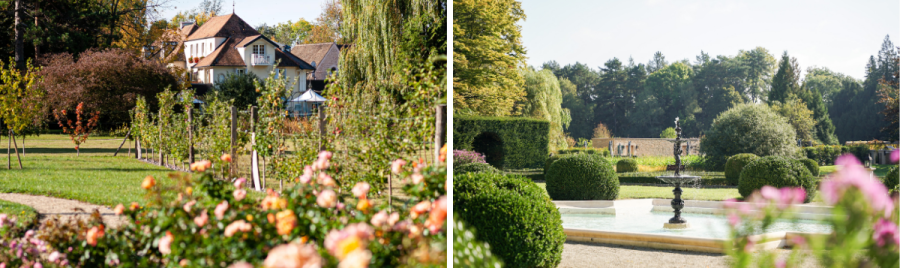
Our home for the journey was l’Hostellerie de Levernois, a five-star Relais & Châteaux retreat set just beyond the ramparts of Beaune. An eighteenth-century country house within a park of century-old trees, threaded by a gentle stream and bordered by its own golf course, it offered the rarest of things: a haven of green calm, minutes from the vineyards, to return to at the end of each day.
What follows is the story of those four days, of the estates that opened their doors, the wines that told us where they came from, and the meals that, in Burgundy, are never quite separate from the wine at all.
Day One: An Introduction at the Table
Burgundy, it is often said, lives at the table, and so it was there that our journey began. The party gathered as the light lengthened over the park at Levernois, then moved through to La Table de Levernois, the Michelin-starred dining room at the heart of the estate, for a first dinner together.
It was an evening designed to set a tone rather than to make a statement, relaxed, unhurried, an easing into the days ahead, yet the wines alone announced the seriousness of what was to come.
Two whites opened in dialogue: a rich, hazelnut-scented Meursault from Domaine Potinet-Ampeau (2017), all breadth and gentle weight, set against the crystalline cut of a Chablis from François Raveneau (2022), a grower whose wines are among the most sought-after in the north. A Beaune Les Grèves from Remoissenet Père et Fils (2019) followed, silken and bright with red fruit, and a structured, earthy Nuits-Saint-Georges Clos des Porrets from Henri Gouges (2022) drew the meal towards its close.
But it was a white that stole the evening. The Chassagne-Montrachet Les Vergers from Fontaine-Gagnard (2020) had a depth and a poise that stopped conversation, ripe orchard fruit, a thread of spice, and that particular tension between richness and precision that is the signature of great white Burgundy. It was, everyone agreed, a memorable way to begin.
Day Two: The Heart of the Côte de Nuits
If the first evening was an introduction, the second day was an immersion. We climbed north into the Côte de Nuits, a thin band of vineyards, rarely more than a few hundred metres wide, that produces the majority of Burgundy’s grands crus, and visited three estates across three villages, each a different expression of the same celebrated slope.
We began in Nuits-Saint-Georges at Marchand-Tawse, the youngest of the houses we would visit and, in many ways, the most quietly revolutionary. Founded only in 2010, it works in two registers at once, as négociant and as domaine, farming organically and biodynamically across some seventy appellations, from humble regional Bourgogne to the loftiest grand cru.
Our tasting was, fittingly, a panorama: fresh, approachable reds in the Côteaux Bourguignons (2023) and Bourgogne Côte d’Or (2021); the bright berry fruit of Marsannay (2021); the balance of Beaune les Tuvilains (2021); the floral delicacy of Monthelie (2022); a poised Vosne-Romanée (2022) and a silken Volnay Frémiets (2022). Two faces of Gevrey-Chambertin, the structured Sélection (2023) and the deeper Champeaux (2023), showed the village’s power, while a trio of whites (a crisp Bourgogne Aligoté, a textured Viré-Clessé and a buttery Meursault, all 2022) and a fine Crémant de Bourgogne rounded out a remarkable range. The wine that held the room, though, was the Clos Saint-Denis (2021): a grand cru of real precision and length, and proof of how much vision a single cellar can hold.
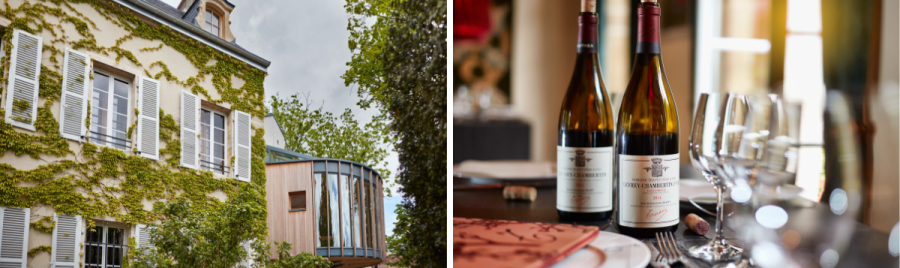
From there we drove the short distance to Gevrey-Chambertin and to Domaine Trapet Père et Fils. To stand with the Trapet family is to stand at the centre of one of Burgundy’s longest unbroken stories, seven generations deep, with holdings in some of the most storied ground on the Côte de Nuits.
Over a hosted lunch, the wines unfolded as a masterclass in the estate’s biodynamic philosophy of restraint and transparency: an aromatic Alsace Schoenenbourg (2019) to begin, then a classic village Gevrey-Chambertin (2017) and its premier cru counterpart, before the grands crus arrived. The velvet-textured Latricières-Chambertin (2017) and the beautifully poised Chapelle-Chambertin (2016) were superb, but it was the Chambertin (2017) itself, the grand cru that Napoleon is said to have carried on campaign, that left the deepest mark: sheer power married to finesse, a wine that seemed to whisper rather than shout.
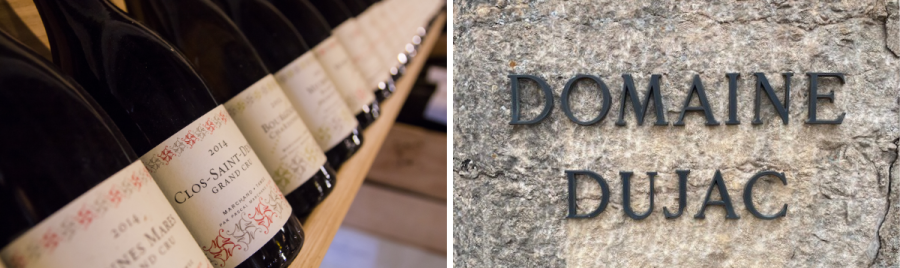
The afternoon brought one of the most anticipated visits of the trip, and a first for our group: Domaine Dujac, in Morey-Saint-Denis. Few estates have achieved so much in so little time. Founded in 1967 by an outsider with fresh eyes and firm convictions, it is the modern classic of the Côte de Nuits.
The wines did not disappoint. From the current vintage came a mineral, deep-set Puligny-Montrachet Les Folatières (2024), a beautifully balanced Morey-Saint-Denis (2024), a rich Gevrey-Chambertin Aux Combottes (2024), and two grands crus, an intense, elegant Clos de la Roche and a powerful, structured Bonnes-Mares (both 2024).
Then came the wines that turned a tasting into an education: a mature Clos de la Roche (2007) of layered, unfurling complexity, and a Clos Saint-Denis (2001) in perfect balance. The 2007 was, for many, the revelation of the day, a glimpse of where these wines are travelling.
The evening closed at Le Carmin, a Michelin-starred room a few steps from the Hospices in the heart of Beaune, where a five-course tasting menu was matched to four wines: a fine, fresh Champagne Grand Cru from Pierre Peters; a bright, mineral Saint-Aubin Murgers Dent de Chien from François Carillon (2020); and a deep, structured Gevrey-Chambertin Les Seuvrées from Hubert Lignier (2019). The star, though, was the Meursault Les Chevalières from Xavier Monnot (2022), rich and complex, and a flawless partner to the kitchen’s precise, seasonal cooking.
Day Three: Great Houses and Old Vines
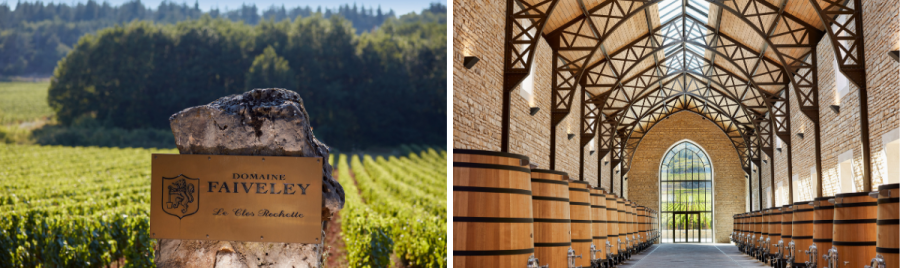
The third day was given to Burgundy’s great historic family houses, and to a moment of quiet pilgrimage. We began at Domaine Faiveley in Nuits-Saint-Georges, a house that has belonged to a single family for two centuries and seven generations, and which in 2025 marked its bicentenary by completing the conversion of its vineyards to certified organic farming.
In a private tasting, we explored some of the estate’s most important climats, a study in the union of scale and conviction, of a house large enough to farm across the whole of the Côte yet exacting enough to treat every parcel as though it were a tiny domaine.
Lunch was taken at Le Millésime, in the very heart of the Côte de Nuits at Chambolle-Musigny, with grand cru slopes visible through the window. Three wines showed the range of the region: a crisp, chiselled Chablis La Forest from Vincent Dauvissat (2022); a floral, high-toned Saint-Aubin Les Frionnes from Hubert Lamy (2020); and a Corton Rognet from Domaine Chevalier (2019) that stood out for its balance and its clear expression of the great Corton hill.
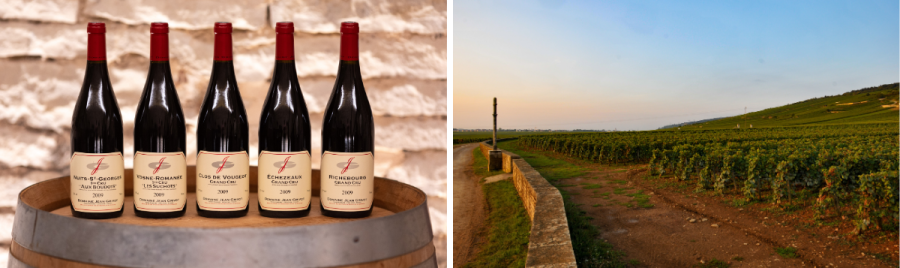
Between courses and cellars came a pause we had all been waiting for. In Vosne-Romanée, the village at the very summit of the Côte de Nuits, we stopped at a low stone wall and a simple cross to look out over the Romanée-Conti vineyard itself: a few rows of vines, worked by horse, that produce what are, by common consent, the most valuable wines on earth. It is a strangely humbling thing to stand before ground so ordinary in appearance and so extraordinary in reputation, and to feel, for a moment, the full weight of what Burgundy means.
The afternoon’s tasting was at Domaine Jean Grivot, whose family has handed down its craft in Vosne-Romanée since the seventeenth century. Here the theme was continuity and precision, a family that has never strayed from its village, working a patchwork of small, precious plots with uncommon care.
The tasting climbed from a light, fruity Bourgogne Pinot Noir (2012) through a poised village Vosne-Romanée (2016), a mature and complex Vosne-Romanée Aux Brûlées (2005), and a powerful Clos de Vougeot (2013). At its summit stood the Vosne-Romanée Les Beaux Monts (1999): a wine of layered flavour and a long, lingering finish, and a reminder that it is the continuity behind these bottles, as much as the wine within them, that lingers in the mind.
Dinner that night was at Clos du Cèdre, another Michelin-starred table, set in a graceful nineteenth-century manor house against the ramparts of Beaune. The seasonal menu was paired with a complex Jacquesson Cuvée 746, a deep and structured Vosne-Romanée Les Haut Beaumonts from Pierre Girardin (2020), and, served, tellingly, in a double pour, the Chassagne-Montrachet from Bernard Moreau (2020), whose richness and precision made it the wine of the evening.
Day Four: A Finale Beneath Beaune
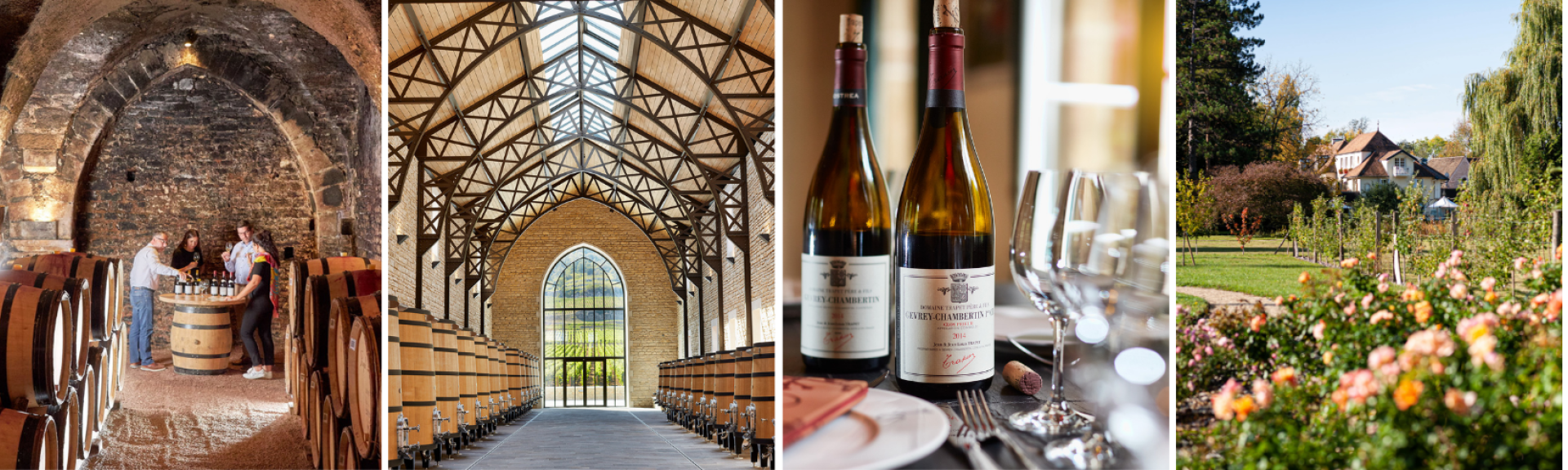
For our final morning, we came to Beaune itself, the walled capital of the wine trade, and to a flagship experience at Maison Joseph Drouhin. From cellars that reach back to the days of the Dukes of Burgundy, some of the oldest in the city, Drouhin has helped define the modern image of the region and has been quietly practising organic and biodynamic farming for more than thirty years. In the estate’s historic underground cellars, our group was given the Rare Tasting: Treasures of the Côte de Nuits, a sequence of wines that formed a fitting crescendo to the journey.
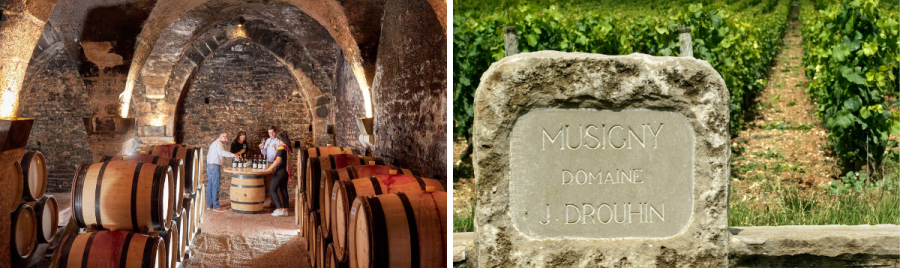
And what a sequence. A luminous Chambolle-Musigny Amoureuses (2021) and a structured Vosne-Romanée Les Petits Monts (2021) gave way to a procession of grands crus, the powerful Clos de Vougeot, the intense and long Grand Échézeaux, the structured Bonnes-Mares and the deep Griotte-Chambertin (all 2021). Two whites, a rich Beaune Clos des Mouches Blanc (2021) and a mineral Chassagne-Montrachet Morgeot (2018), and a bright Saint-Romain (2022), completed the flight.
But the wine everyone would remember was the Musigny (2021): a grand cru of such depth and so long and velvety a finish that our host reached past “silk” for a better word and settled, perfectly, on cashmere.
A hosted lunch at the estate followed, and then, in the early afternoon, the journey drew gently to its close, guests returning to Levernois to depart at their leisure.
A Night in Beaune
Not every memory of the trip was made in a cellar. On one of our last evenings, the party ventured out into Beaune on its own, for a slow walk through the old town as the light faded. The illuminated church and the great glazed roof of the Hôtel-Dieu, the fifteenth-century Hospices de Beaune, still a masterpiece of Gothic architecture, were breathtaking in the dusk: a reminder that this is a place whose history is measured not only in vintages but in centuries.
The Ground and the Glass
Four days is not long, and yet Burgundy has a way of making time feel dense. We had moved from generous regional wines to the rarest grands crus; from a house founded in 2010 to families whose roots reach back four hundred years; from the biodynamic idealism of Trapet and Dujac to the heritage-in-motion of Faiveley and Drouhin. What united them, every estate, every glass, was a single conviction: that a wine should taste of the ground it comes from, and that the winemaker’s task is not to impose, but to reveal.
At Cult Wines we believe that discovering wine means more than tasting it. It means walking the vineyards, meeting the people who tend them, and standing on the ground itself. Our thanks go to the estates who welcomed us so generously, to the tables that hosted us each night, and above all to the clients who shared these four days with such curiosity and warmth. Until next time, Burgundy.
Our Burgundy Wine List:
Every wine tasted across the four days in the order we met them. Highlights of each stop are indicated with a star.
| DAY ONE | |||
| WELCOME DINNER, LA TABLE DE LEVERNOIS | |||
| MeursaultDomaine Potinet-Ampeau | Domaine Potinet-Ampeau | 2017 | |
| ChablisDomaine François Raveneau | Domaine François Raveneau | 2022 | |
| ★ Chassagne-Montrachet Les VergersDomaine Fontaine-Gagnard | Domaine Fontaine-Gagnard | 2020 | |
| Beaune Les GrèvesRemoissenet Père et Fils | Remoissenet Père et Fils | 2019 | |
| Nuits-Saint-Georges Clos des PorretsDomaine Henri Gouges | Domaine Henri Gouges | 2022 | |
| TASTING AT MARCHAND-TAWSE, NUITS-SAINT-GEORGES | |||
| Coteaux BourguignonsMarchand-Tawse | Marchand-Tawse | 2023 | |
| Bourgogne Côte d’Or Pinot NoirMarchand-Tawse | Marchand-Tawse | 2021 | |
| MarsannayMarchand-Tawse | Marchand-Tawse | 2021 | |
| Beaune les TuvilainsMarchand-Tawse | Marchand-Tawse | 2021 | |
| MonthelieMarchand-Tawse | Marchand-Tawse | 2022 | |
| Vosne-RomanéeMarchand-Tawse | Marchand-Tawse | 2022 | |
| Volnay FrémietsMarchand-Tawse | Marchand-Tawse | 2022 | |
| Gevrey-Chambertin SélectionMarchand-Tawse | Marchand-Tawse | 2023 | |
| Gevrey-Chambertin ChampeauxMarchand-Tawse | Marchand-Tawse | 2023 | |
| ★ Clos Saint-Denis, Grand CruMarchand-Tawse | Marchand-Tawse | 2021 | |
| Bourgogne AligotéMarchand-Tawse | Marchand-Tawse | 2022 | |
| Viré-ClesséMarchand-Tawse | Marchand-Tawse | 2022 | |
| MeursaultMarchand-Tawse | Marchand-Tawse | 2022 | |
| Crémant de BourgogneMarchand-Tawse | Marchand-Tawse | NV | |
| LUNCH & TASTING AT DOMAINE TRAPET PÈRE ET FILS, GEVREY-CHAMBERTIN | |||
| Alsace SchoenenbourgDomaine Trapet Père et Fils | Domaine Trapet Père et Fils | 2019 | |
| Gevrey-ChambertinDomaine Trapet Père et Fils | Domaine Trapet Père et Fils | 2017 | |
| Gevrey-Chambertin Premier CruDomaine Trapet Père et Fils | Domaine Trapet Père et Fils | 2017 | |
| ★ Chambertin, Grand CruDomaine Trapet Père et Fils | Domaine Trapet Père et Fils | 2017 | View on CultX |
| Latricières-Chambertin, Grand CruDomaine Trapet Père et Fils | Domaine Trapet Père et Fils | 2017 | View on CultX |
| Chapelle-Chambertin, Grand CruDomaine Trapet Père et Fils | Domaine Trapet Père et Fils | 2016 | View on CultX |
| DAY TWO | |||
| TASTING AT DOMAINE DUJAC, MOREY-SAINT-DENIS | |||
| Puligny-Montrachet Les FolatièresDomaine Dujac | Domaine Dujac | 2024 | |
| Morey-Saint-DenisDomaine Dujac | Domaine Dujac | 2024 | |
| Gevrey-Chambertin Aux CombottesDomaine Dujac | Domaine Dujac | 2024 | |
| Clos de la Roche, Grand CruDomaine Dujac | Domaine Dujac | 2024 | |
| Bonnes-Mares, Grand CruDomaine Dujac | Domaine Dujac | 2024 | |
| ★ Clos de la Roche, Grand CruDomaine Dujac | Domaine Dujac | 2007 | |
| Clos Saint-Denis, Grand CruDomaine Dujac | Domaine Dujac | 2001 | |
| DINNER AT LE CARMIN, BEAUNE | |||
| Champagne Grand CruPierre Peters | Pierre Peters | NV | |
| ★ Meursault Les ChevalièresXavier Monnot | Xavier Monnot | 2022 | |
| Saint-Aubin Murgers Dent de ChienDomaine François Carillon | Domaine François Carillon | 2020 | |
| Gevrey-Chambertin Les SeuvréesDomaine Hubert Lignier | Domaine Hubert Lignier | 2019 | View on CultX |
| DAY THREE | |||
| LUNCH AT LE MILLÉSIME, CHAMBOLLE-MUSIGNY | |||
| Chablis La ForestDomaine Vincent Dauvissat | Domaine Vincent Dauvissat | 2022 | |
| Saint-Aubin Les FrionnesDomaine Hubert Lamy | Domaine Hubert Lamy | 2020 | |
| ★ Corton RognetDomaine Chevalier | Domaine Chevalier | 2019 | |
| TASTING AT DOMAINE JEAN GRIVOT, VOSNE-ROMANÉE | |||
| Bourgogne Pinot NoirDomaine Jean Grivot | Domaine Jean Grivot | 2012 | |
| Vosne-RomanéeDomaine Jean Grivot | Domaine Jean Grivot | 2016 | View on CultX |
| Vosne-Romanée Aux BrûléesDomaine Jean Grivot | Domaine Jean Grivot | 2005 | |
| ★ Vosne-Romanée Les Beaux MontsDomaine Jean Grivot | Domaine Jean Grivot | 1999 | |
| Clos de Vougeot, Grand CruDomaine Jean Grivot | Domaine Jean Grivot | 2013 | View on CultX |
| DINNER AT CLOS DU CÈDRE, BEAUNE | |||
| Jacquesson Cuvée 746 (Champagne)Jacquesson | Jacquesson | NV | |
| Vosne-Romanée Les Haut BeaumontsPierre Girardin | Pierre Girardin | 2020 | View on CultX |
| ★ Chassagne-Montrachet (served twice)Domaine Bernard Moreau | Domaine Bernard Moreau | 2020 | View on CultX |
| DAY FOUR | |||
| RARE TASTING AT MAISON JOSEPH DROUHIN, BEAUNE | |||
| Chambolle-Musigny AmoureusesMaison Joseph Drouhin | Maison Joseph Drouhin | 2021 | |
| Vosne-Romanée Les Petits MontsMaison Joseph Drouhin | Maison Joseph Drouhin | 2021 | |
| Clos de Vougeot, Grand CruMaison Joseph Drouhin | Maison Joseph Drouhin | 2021 | View on CultX |
| Grand Échézeaux, Grand CruMaison Joseph Drouhin | Maison Joseph Drouhin | 2021 | |
| Bonnes-Mares, Grand CruMaison Joseph Drouhin | Maison Joseph Drouhin | 2021 | |
| Griotte-Chambertin, Grand CruMaison Joseph Drouhin | Maison Joseph Drouhin | 2021 | |
| ★ Musigny, Grand CruMaison Joseph Drouhin | Maison Joseph Drouhin | 2021 | |
| Beaune Clos des Mouches BlancMaison Joseph Drouhin | Maison Joseph Drouhin | 2021 | |
| Chassagne-Montrachet MorgeotMaison Joseph Drouhin | Maison Joseph Drouhin | 2018 | View on CultX |
| Saint-RomainMaison Joseph Drouhin | Maison Joseph Drouhin | 2022 | |
Related Articles
Georgia: The Ancient Homeland of Wine
By Jessie Wu