Wine Critics: A History of Taste, Scores and Influence
Wine criticism occupies a peculiar position in the world of fine wine. A critic cannot improve the weather, alter a vineyard’s geology or make a bottle taste better. Yet a few words and a number published after a tasting can change demand for a wine, influence its release price, determine how quickly merchants sell their allocations and, in exceptional cases, follow that bottle through the secondary market for decades. For collectors and investors, critics are therefore difficult to ignore. Their judgements are not objective measurements in the way that alcohol, acidity or residual sugar can be measured, but neither are they merely decorative opinions. A recognised critic’s score can become part of a wine’s commercial identity. Auction catalogues quote critics. Merchants reproduce their tasting notes. Producers celebrate high scores in marketing material. Collectors use them to compare vintages, decide what to buy en primeur and determine whether an unfamiliar producer deserves cellar space.
Yet the wine critic as we now understand the term is surprisingly modern. People have judged wines for thousands of years, but for most of that history the people doing the judging were not independent reviewers publishing regular assessments for consumers. They were drinkers, merchants, physicians, landowners, brokers, gastronomes, writers and, occasionally, rulers. Reputation travelled through trade and society long before it travelled through specialist magazines. The history of wine criticism is consequently larger than the history of Robert Parker, the 100-point scale or even professional wine writing. It is the story of how private judgement became public information, how public information became authority, and how authority eventually became capable of affecting the price of a bottle.
Before the modern wine critic
Long before anyone was called a wine critic
There is no sensible date on which wine criticism can be said to have begun. What can be identified much earlier is the habit of comparing wines and deciding that some were better, more desirable or more prestigious than others. Ancient Greek literature contains numerous references to wines identified by their places of origin. Later writers preserved discussions of the wines of islands and regions such as Chios, Thasos and Lesbos, sometimes distinguishing between styles and levels of quality. Athenaeus, writing around the turn of the third century AD and drawing heavily on earlier Greek authors, collected descriptions and judgements that make clear how developed this culture of comparison had become.
The Romans went further in documenting it. Pliny the Elder’s Natural History, written in the first century AD, contains passages that look remarkably familiar to anyone who reads wine commentary today. He discusses famous origins, relative quality, ageing, style, fashionable preferences and declining standards. He tells us that Augustus favoured Setine wine. He describes Caecuban wine as having once enjoyed the highest reputation, and Falernian as occupying the summit of the contemporary hierarchy. He even complains that the quality of Falernian had deteriorated because growers were more concerned with quantity than excellence. Nearly two thousand years later, complaints about yields, commercialisation and falling standards would not sound out of place in a modern vintage report.
Pliny also records the extraordinary reputation of the Opimian vintage of 121 BC, wine from the consulship of Lucius Opimius that survived into his own era. The precise sensory experience of such ancient wines is unknowable, but the significance is considerable. Vintage identity mattered. Age mattered. Provenance mattered. Certain places commanded greater esteem than others, and writers could reinforce those reputations by recording them. Pliny was not a wine critic in the modern professional sense. He did not publish annual buying recommendations or score hundreds of wines in controlled comparative tastings. Nor should ancient wine hierarchies be mistaken for modern blind assessment. Social prestige, rarity, medical beliefs, fashion and the preferences of powerful people were entangled with judgements of quality. Even so, the underlying behaviour is recognisable. Wine drinkers wanted to know which origins were best, which vintages had succeeded and which wines deserved greater esteem. That desire never disappeared.
When the market was the critic
For much of European wine history, there was little need for an independent critic because judgement was embedded within the commercial system itself. Wine moved through networks of growers, monasteries, landowners, négociants, merchants, innkeepers, brokers and wealthy customers. Knowledge of quality was valuable, but it was often proprietary knowledge. A merchant who could distinguish the reliable vineyard from the fashionable fraud, or the successful vintage from the weak one, possessed a commercial advantage.
Reputation accumulated around places. Burgundy developed increasingly precise distinctions between vineyards. German and Austrian wines acquired reputations connected to site, grape and ripeness. Port shippers and Madeira merchants developed their own hierarchies. Champagne houses built brands around blending and consistency. Bordeaux became particularly important because its commercial classification evolved so visibly through market prices. Long before the official Bordeaux Classification of 1855, merchants and buyers were already distinguishing between leading estates. Thomas Jefferson, while serving as American minister to France, recorded his own hierarchy of Bordeaux properties during his travels in 1787. His notes were those of an unusually diligent consumer rather than a professional critic, but they show that the concept of ranking estates was already well established.
The 1855 Classification made the relationship between judgement and money explicit. Napoleon III wanted Bordeaux’s leading wines presented systematically for the Exposition Universelle in Paris. The Bordeaux Chamber of Commerce turned to the brokers, who were immersed in the market and knew how estates were regarded by buyers. Reputation and recent market prices became central criteria. This was not criticism in the modern journalistic sense. No single taster sat down and awarded Lafite, Latour or Margaux a numerical score. Instead, accumulated market judgement was formalised into tiers.
That distinction matters. Modern consumers often imagine that classifications were created as pure statements of intrinsic quality. In reality, commercial reputation and quality have been intertwined for centuries. The difference today is that the market often reacts to critics. In 1855, the market itself was part of the critical mechanism. The classification also illustrates something that still troubles wine criticism: a judgement can outlive the conditions that produced it. The hierarchy has proved extraordinarily durable, despite changes in ownership, vineyard management, winemaking and performance. Château Mouton Rothschild’s promotion from Second to First Growth in 1973 remains the famous exception. A score may seem temporary because it belongs to one tasting on one day. A classification shows the opposite danger. Once judgement becomes institutionalised, it can acquire a life far longer than the evidence on which it was originally based.
The nineteenth century and the beginnings of systematic wine writing
The modern critic required more than expertise. Criticism could only become a profession once information about wine could be collected, organised, published and distributed to readers who were not themselves merchants. The nineteenth century provided increasingly fertile conditions for that development.
One of the most remarkable early figures was André Jullien. His Topographie de tous les vignobles connus, published in 1816, attempted something extraordinarily ambitious: to describe the world’s known vineyards, their products, quality, commercial practices and relative standing, followed by a general classification of wines. Jullien was not simply telling readers that one bottle had pleased him more than another. He was trying to impose order on an enormous and confusing international wine trade. His classifications divided wines into levels of quality and brought together information about origins that most consumers could never have visited. That makes him one of the clearest ancestors of the modern wine-guide author.
In Britain, Cyrus Redding’s A History and Description of Modern Wines, first published in 1833, performed a related function for English-speaking readers. It discussed French, German, Spanish, Portuguese and other wines and combined history, description, trade knowledge and classification. These books belong to an era before the tasting-note database, before the specialist magazine and before the critic whose principal output consists of individual scores. Their importance lies in the shift they represent. Wine expertise was becoming something that could be packaged for the independent reader. The reader no longer had to rely entirely on the merchant selling the bottle. That change sounds modest, but it is fundamental to everything that followed.
From the cultivated amateur to the professional wine writer
The twentieth century brought a different sort of authority. George Saintsbury’s Notes on a Cellar-Book, published in 1920, remains a landmark of English wine literature precisely because it was intensely personal. Saintsbury wrote about bottles he had drunk, meals he remembered, preferences he had developed and the accumulated pleasures of a lifetime. He belonged to what might be called the cultivated amateur tradition, using “amateur” in its older and more complimentary sense: a person deeply devoted to a subject without needing to turn every judgement into a system. His authority came from experience, memory and prose rather than a score.
That tradition remained powerful in Britain, where wine writing developed differently from the numerical culture that would later dominate the United States. André Simon was pivotal. Born in France but closely associated with British wine culture, Simon helped found the Wine and Food Society in London in 1933 with A. J. A. Symons. Its journal followed in 1934. Simon wrote prolifically and treated wine as part of gastronomy and civilisation rather than merely as an alcoholic commodity. His importance is easy to underestimate in a score-driven age. Simon helped create a community of informed consumers. Tastings, dinners, books, societies and journalism turned wine knowledge from something held predominantly within the trade into a subject that enthusiastic private drinkers could study.
In the United States, Frank Schoonmaker played a comparable educational role. His Complete Wine Book appeared in 1934, just after the end of Prohibition. Schoonmaker, and later figures such as Alexis Lichine, helped explain European wine to an American public whose modern wine culture was still being rebuilt. Both men also illustrate a complication that would eventually help produce the independent critic. Wine writers frequently had commercial connections with the trade. They might import, sell, promote or consult as well as write. That was not automatically improper. In a relatively small wine world, expertise often came from participation in the business. But it created a question that Robert Parker would later make central to his own philosophy: could the person recommending the wine be truly independent of the people selling it?
The rise of modern wine authority
Britain builds a culture of wine authority
After the Second World War, wine became more accessible to a broader British public. The generation of writers that emerged during the following decades transformed how consumers learned about it. Pamela Vandyke Price was a pioneering figure. At a time when British wine writing was overwhelmingly male, she became a prominent newspaper and magazine authority, eventually serving as wine correspondent for The Times. Her work coincided with the expansion of mass interest in wine and helped replace some of the old clubbish mystique with more practical instruction.
Michael Broadbent brought another kind of authority. In 1966 he established Christie’s specialist wine auctions. His work placed the professional taster at the centre of the developing international market for rare and mature bottles. Broadbent’s tasting notes became particularly valuable because he often tasted wines across extraordinary spans of age. A critic reviewing current releases asks what a young wine might become. An auction specialist repeatedly encounters what those wines actually became. His five-star shorthand was memorable, but his greater contribution was the accumulation of tasting memory. For collectors of mature Bordeaux, Burgundy, Port, and other classics, this was a different form of criticism from that of a new vintage. It helped establish condition, longevity and historical performance as subjects worthy of systematic commentary.
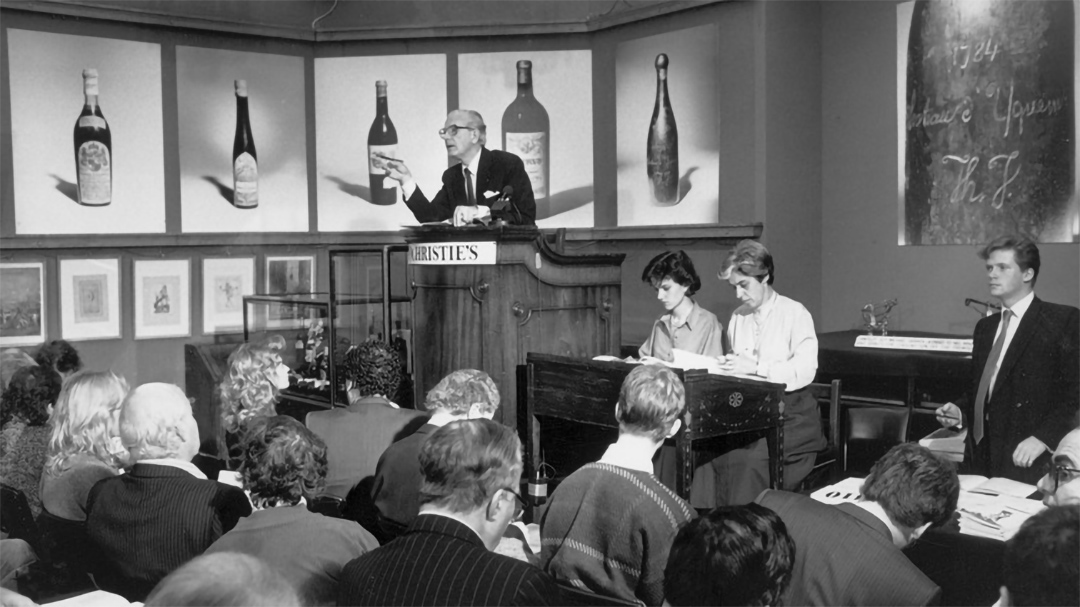
Michael Broadbent at Christie’s specialist wine auctions
Serena Sutcliffe MW later occupied a similarly important place at Sotheby’s, where she served as worldwide head of wine for 25 years from 1990 to 2015. Auction specialists such as Broadbent and Sutcliffe remind us that wine criticism has always extended beyond magazines. In the secondary market, the ability to understand old bottles, provenance, maturity and reputation can be at least as consequential as assessing a young barrel sample.
Hugh Johnson represents yet another branch of the same family tree. The first edition of The World Atlas of Wine appeared in 1971. Johnson demonstrated that a writer could become one of the most influential voices in wine without reducing every judgement to a number. Geography, history, producer reputation, vintage character and stylistic description could guide buyers just as effectively. Jancis Robinson would continue that tradition while developing a more systematic scoring language of her own.
Robinson entered professional wine journalism in the 1970s and became the first person outside the wine trade to pass the Master of Wine examination in 1984. Her career has included books, television, newspaper columns, reference works and an extensive subscription website. Unlike many American critics, she retained a 20-point system and has always expressed reservations about pretending that wine quality can be represented with mathematical precision. Clive Coates MW was another towering British specialist, particularly for Burgundy and Bordeaux. His newsletter The Vine, launched in 1984 and continued for more than two decades, became a model of subscription-based specialist criticism. Coates’s authority came from repeated visits, deep regional knowledge and long-form analysis rather than the fame of a single score.
Meanwhile, television changed the social reach of wine expertise. Oz Clarke and Jilly Goolden became familiar to millions of British viewers through the BBC’s Food & Drink during the 1980s and 1990s. Their importance was different from Parker’s. They were not primarily moving the prices of classed-growth Bordeaux. They were helping remove the fear surrounding wine. That matters to the history of criticism because critics do more than rank expensive bottles. They teach people how to talk about taste.
1976 and the moment authority became portable
The 1970s were a turning point. Decanter was founded in London in 1975. Wine Spectator first appeared in the United States in 1976. Specialist wine journalism was becoming increasingly accessible to ordinary consumers. Then, on 24 May 1976, Steven Spurrier and Patricia Gallagher organised the tasting that became known as the Judgment of Paris.
The format now seems entirely familiar: wines were presented blind, and judges compared them without seeing the labels. Yet the consequences were astonishing. California Chardonnay was placed alongside white Burgundy, and California Cabernet Sauvignon alongside red Bordeaux. French judges ranked the 1973 Chateau Montelena Chardonnay first among the whites and the 1973 Stag’s Leap Wine Cellars Cabernet Sauvignon first among the reds.
The tasting did not prove that California wine was universally better than French wine, nor could one tasting possibly settle such a question. What it did was much more significant. It demonstrated that established reputation could be challenged by comparative tasting. A label was no longer enough. For wine criticism, this was an important philosophical moment. Blind tasting offered a way to separate the liquid, at least temporarily, from the prestige surrounding it. It reinforced the idea that an expert’s task was not merely to repeat the accepted hierarchy but to test it. That principle would become central to some publications, while others would later argue that knowing a wine's identity and context yields a more useful assessment. The debate remains unresolved because both positions contain truth.
Robert Finigan, Robert Parker and the American newsletter
Before Robert Parker became the dominant American critic, Robert Finigan had already shown that subscribers would pay for independent recommendations. Finigan’s Private Guide to Wines, launched in the early 1970s, was an influential consumer newsletter at a time when American interest in fine wine was expanding rapidly. His opinions were respected enough that his reaction to the 1982 Bordeaux vintage mattered. Finigan was cautious about those unusually ripe, approachable young wines. A young Maryland lawyer named Robert M. Parker Jr was not.
Parker founded what became The Wine Advocate in 1978. He framed his role explicitly around consumer advocacy. He had been influenced by the American consumer movement and by post-Watergate concerns about conflicts of interest. He wanted readers to believe that the critic represented them rather than producers, importers or advertisers. This was not simply a matter of tasting ability. It was a business model.
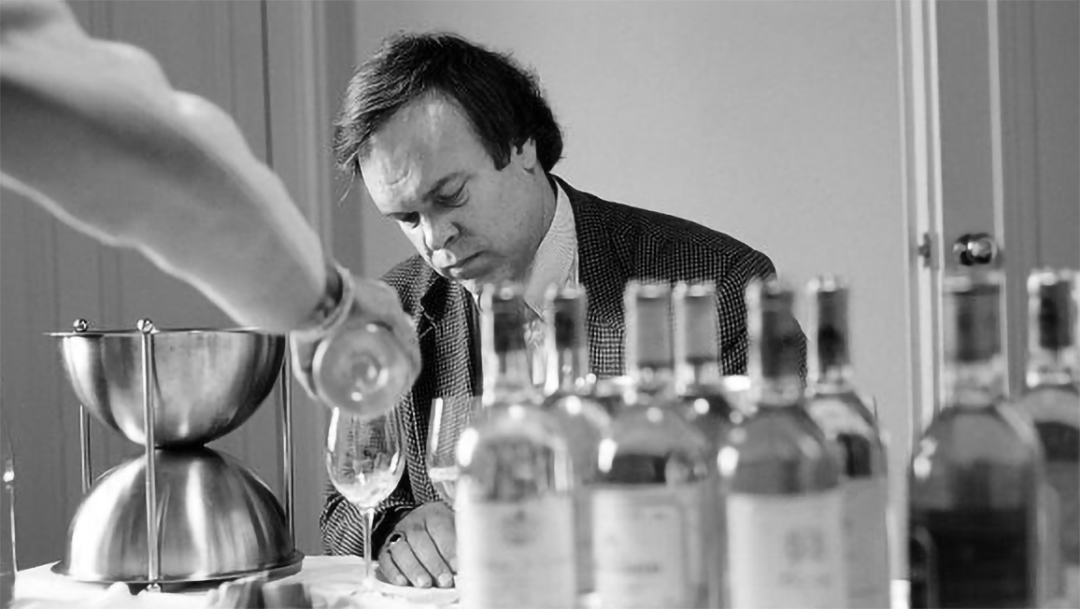
Robert M. Parker Jr Wine Advocate
Parker’s newsletter accepted no conventional wine advertising. Subscribers paid for the information. That separation became part of his authority and would later inspire other critics to build subscription-funded publications. The decisive episode was Bordeaux 1982. The vintage produced ripe, generous young wines that some established observers worried might develop too quickly. Parker argued strongly that the vintage was exceptional and encouraged readers to buy.
He was not solely responsible for the commercial success of 1982. The American economy, a strong dollar, increased interest in Bordeaux, speculation, and the quality and volume of the vintage all played a part. Yet Parker’s confidence, and the subsequent development of the wines, elevated his reputation dramatically. In January 1984, he awarded his first 100-point scores to the 1982 Pétrus and Mouton Rothschild. A new era had begun.
Why Parker changed wine criticism
Parker’s significance did not come from being the first person to assign numbers to wine. He was not. The University of California at Davis had developed a 20-point analytical scoring system decades earlier. British critics used stars and points. Competitions used medals. Consumers were accustomed to ranked products.
Parker’s achievement was to combine several elements in a particularly powerful form. First, the 100-point format looked immediately understandable to American readers familiar with school grades. A 95 appeared intuitively better than a 90. Second, he paired the number with detailed prose. The score was a shorthand, not originally intended to replace the tasting note. Third, he positioned himself as independent from the trade. Fourth, he developed extraordinary coverage of regions, particularly Bordeaux and the Rhône, precisely when international demand for fine wine was expanding. Finally, the score was commercially portable.
A long tasting note needs to be read. “96 points, Robert Parker” can be printed on a merchant’s offer, a shelf talker, an auction listing or a producer’s marketing sheet. That portability changed wine commerce. It also changed how consumers thought. Wine had always possessed hierarchies. Parker gave those hierarchies a number that appeared precise enough to compare one bottle with another.
Points, stars and the language of quality
The 100-point scale is not really a 100-point scale
This point causes endless confusion. Most wine critics who use a “100-point scale” do not meaningfully use all 100 numbers. Parker’s system effectively begins at 50. In the traditional Wine Advocate interpretation, 50 to 59 represents unacceptable wine; 60 to 69, below-average wine; 70 to 79, average wine; 80 to 89, wines ranging from slightly above average to very good; 90 to 95, outstanding wine; and 96 to 100, extraordinary wine.
For the fine-wine buyer, the usable range is narrower still. A merchant offering young-classified Bordeaux, grand cru Burgundy, Barolo, Napa Cabernet, or prestige Champagne is unlikely to fill its catalogue with 72-point wines. The wines under consideration have already passed multiple filters, including producer reputation, price, appellation, and selection. As a result, much of the commercial conversation takes place between roughly 90 and 100.
This creates the strange situation in which a supposedly 100-point scale can behave more like a ten-point scale, and sometimes like a five-point scale. A 90 once sounded outstanding because that is what the published definitions said. In some parts of the contemporary fine-wine market, 90 can now feel disappointing. This is score compression, and it is one reason collectors should understand the critic rather than merely the number. A 95 from one reviewer is not automatically equivalent to a 95 from another.
The principal wine scoring systems
The following table covers the systems collectors are most likely to encounter. The categories are useful guides rather than mathematical conversion formulas. There is no reliable equation that turns 18/20 from one critic into 94/100 from another.
| Critic, publication or guide | Scale | How it works |
|---|---|---|
| Robert Parker Wine Advocate | 50-100 | Traditional bands run from unacceptable at 50-59 through average at 70-79, very good territory in the 80s, outstanding at 90-95 and extraordinary at 96-100. Its commercial success established the dominant modern fine-wine format. |
| Wine Spectator | 50-100 | 95-100 Classic, 90-94 Outstanding, 85-89 Very Good, 80-84 Good, 75-79 Mediocre and 50-74 Not Recommended. Wines are reviewed using blind-tasting procedures. |
| Wine Enthusiast | 80-100 for published reviews | 98-100 Classic, 94-97 Superb, 90-93 Excellent, 87-89 Very Good, 83-86 Good and 80-82 Acceptable. Wines scoring below 80 are not published. Tastings are conducted blind in peer groups. |
| Decanter | 50-100 | Its panel scale runs from Faulty at the bottom through Fair, Commended and Recommended to Highly Recommended at 90-94, Outstanding at 95-97 and Exceptional at 98-100. Panel tastings are conducted anonymously. |
| Decanter World Wine Awards | 100 points translated into medals | Bronze 86-89, Silver 90-94, Gold 95-96 and Platinum 97-100, followed by a further stage for Best in Show. This is competition judging rather than criticism by a single named reviewer. |
| JancisRobinson.com | 20 points | 20 is Truly Exceptional, 19 a “humdinger”, 18 a cut above superior, 17 Superior, 16 Distinguished and 15 Average. Lower marks descend into dull, unbalanced or faulty territory. Half-points and occasional plus signs add resolution. |
| UC Davis system | 20 points | Created for technical evaluation rather than modern consumer recommendation. Points are allocated across sensory and structural categories. Historically important because it predates today’s commercial scoring culture. |
| Halliday Wine Companion | 100 points with glass symbols | Australia’s major guide uses a 100-point framework alongside visual quality categories. Scores in the mid-90s and above occupy its highest levels. The modern Companion is produced by a tasting team rather than James Halliday alone. |
| The Real Review | 100 points, five-star display and ribbons | Gold ribbons correspond to 95-100, Silver to 90-94 and Bronze to 85-89. The publication also uses star imagery, providing a bridge between traditional stars and modern points. |
| Platter’s South African Wine Guide | 100 points with 20-point equivalents and Five Star recognition | A useful example of a guide adapting older scoring traditions to the internationally familiar 100-point format while retaining its historic Five Star identity. |
| Guía Peñín | 50-100 | Spain’s major guide originally used a 0-10 system before adopting the American-style 50-100 scale in the 1990s. Very highly rated wines are re-tasted comparatively. |
| Bettane+Desseauve | 100 points | Modern editions use 86-89 for good wines, 90-92 very good, 93-96 benchmark quality, 97-99 exceptional and 100 for something approaching perfection on the day of tasting. |
| Gambero Rosso Vini d’Italia | One, two or three glasses | One of the most famous alternatives to numerical scores. Tre Bicchieri, three glasses, is the highest award and has become an internationally recognised mark of Italian wine quality. |
| Guide Hachette des Vins | Stars rather than 100 points | Wines selected through blind regional tastings can receive one, two or three stars, with Coup de Cœur marking particular favourites. It remains a powerful example of criticism that does not need a 100-point number. |
| CellarTracker | Community 50-100 scale | Thousands of private drinkers record scores and tasting notes. It follows familiar letter-style bands, but its greatest value for collectors often lies in repeated reports on how mature bottles are drinking. |
| Vivino | 1-5 stars | A mass-market community system based on consumer ratings rather than professional criticism. Its scale is simpler and its population vastly broader than a specialist critic’s readership. |
There have been many other systems. Michael Broadbent famously used stars. Some writers prefer recommendations without scores. Competitions use trophies and medals. Restaurant critics and buyers sometimes work with letter grades. Individual tasters invent their own internal shorthand. No scale solves the fundamental problem that taste is a matter of judgement rather than measurement.
Jancis Robinson and the case for 20 points
Jancis Robinson’s continued use of a 20-point scale is particularly instructive because it exposes how arbitrary the apparent precision of 100 points can be. On her scale, 17 is already “superior”. An 18 is a seriously impressive wine. Nineteen is exceptional territory, and 20 is genuinely rare.
A reader accustomed to the American scale can easily look at 17/20 and subconsciously interpret it as 85 per cent. That is wrong. The scales are constructed differently. An 18/20 Robinson score should not be multiplied by five and treated mechanically as 90/100. Nor should a 95 from one 100-point critic be converted into an exact Robinson equivalent.
The critic’s distribution matters. Some reviewers use 100 readily. Others reserve it for extraordinary cases. Some concentrate enormous numbers of wines between 92 and 97. Others are happier publishing scores in the high 80s. The number only acquires meaning when you understand who gave it.
The five-star tradition
Stars have one major advantage over points: they make less pretence to precision. A five-star wine is clearly highly regarded. A four-star wine is excellent but not quite in the highest category. Nobody is encouraged to believe that the difference between 95 and 96 represents a measurable unit of quality.
Their disadvantage is resolution. When dozens of serious wines are tasted together, especially in a region such as Burgundy where tiny differences between sites and producers may matter enormously to collectors, five categories can feel too broad. This is one reason numerical scales became so popular with professional reviewers. They allow a critic to say that Wine A was marginally preferred to Wine B without writing an essay every time. The danger begins when readers start treating that marginal preference as scientific fact.
From the superstar critic to the specialist
The rise of the specialist critic
Parker’s success encouraged both imitation and specialisation. Stephen Tanzer built an exceptionally respected following through International Wine Cellar. His reviews used the 100-point scoring system, but his reputation was associated with careful calibration, detailed tasting notes, and broad regional expertise. Vinous acquired International Wine Cellar in 2014, bringing Tanzer’s work and editorial heritage into Antonio Galloni’s growing publication.
Allen Meadows took specialisation further with Burghound, concentrating heavily on Burgundy. For serious Burgundy collectors, such narrow focus can be an advantage. A critic who repeatedly tastes the same domaines, vineyards and barrel samples develops a reference library that a generalist covering twenty countries cannot easily reproduce.
James Halliday became a defining authority in Australia. His books and annual Wine Companion helped build a critical framework for a country whose fine-wine reputation expanded enormously in the late twentieth and early twenty-first centuries. Halliday eventually stepped back from reviewing, and the Companion now operates through a substantial panel of regional tasters, illustrating how a publication can retain the identity of its founder while becoming an institution.
James Suckling took another route. After a long career at Wine Spectator, where he became particularly associated with Bordeaux and Italian wine, he established JamesSuckling.com. It has developed into a large international reviewing operation with tasters working across major regions.
Antonio Galloni, originally known for his work on Piedmont before joining The Wine Advocate, founded Vinous in 2013. Vinous later incorporated Tanzer’s International Wine Cellar and expanded into a broad team that today includes Neal Martin, Rebecca Gibb MW, Eric Guido, Anne Krebiehl MW, Joaquín Hidalgo and other regional specialists.
Neal Martin is one of the most closely followed modern critics for Bordeaux and Burgundy. His career is also a good illustration of the post-Parker era. He built an independent following, joined The Wine Advocate, then moved to Vinous, taking his audience and authority with him. The critic, rather than the publication alone, had become the brand.
The critics who shaped national markets
A global history cannot stop with Britain and the United States. France developed its own powerful institutional voices. La Revue du vin de France, founded in 1927, became one of the country’s central wine publications. Michel Bettane and Thierry Desseauve became major French critics through their work there and later through their own guide and media business. French consumers have also long relied on guide-based assessment, especially Guide Hachette des Vins, whose star system and blind regional tastings remain conspicuously different from the Anglo-American cult of the individual critic.
Italy had Luigi Veronelli. Veronelli was not simply a reviewer assigning approval to bottles. From the 1960s onwards, he argued passionately for Italy’s vineyards, growers, local identities and superior sites. His advocacy of the concept of cru, small-scale farming and lower yields helped shape the language through which modern Italian fine wine came to understand itself. Later, Vini d’Italia from Gambero Rosso turned the Tre Bicchieri award into one of Italian wine’s most commercially recognisable distinctions. A producer did not need “97 points” on the shelf. Three glasses could perform the same signalling function.
Spain developed an equivalent reference point through José Peñín and Guía Peñín. The first guide appeared in 1990, and the scoring system eventually shifted from a Spanish-style ten-point approach to the 50-100 model as the latter became internationally dominant.
Australia had Halliday. New Zealand has long had influential local authorities, including Bob Campbell MW. South Africa’s Platter’s guide created a national reference framework built around teams of tasters rather than a single international celebrity, while critics such as Tim Atkin MW and Neal Martin later gave South African fine wine another channel into global collector markets.
The important point is that there has never been only one culture of criticism. Parker was exceptionally powerful, but the world did not simply become American.
Who matters now? The major critics and reviewing ecosystems today
No honest article can list “all” current wine critics. There are hundreds of active reviewers working in print, on subscription sites, in newspapers, in competitions, in national guides, and in local markets. A directory that attempted to be complete would be out of date almost immediately. For collectors, the more useful question is: whose names are you likely to encounter when researching, buying, selling or valuing serious wine?
The following is a working map rather than a ranking.
| Area | Critics and reviewing voices particularly relevant to collectors |
|---|---|
| Bordeaux | William Kelley, Neal Martin, Antonio Galloni, James Suckling, Jeb Dunnuck, Jane Anson, Lisa Perrotti-Brown MW, Chris Kissack, Georgina Hindle and James Molesworth are among the names collectors regularly encounter. Bordeaux remains one of the few regions where several international critics can materially shape discussion of the same release campaign. |
| Burgundy and Chablis | Neal Martin, William Kelley, Allen Meadows, Jasper Morris MW, Charles Curtis MW, Sarah Marsh MW and Antonio Galloni form part of a particularly specialised critical culture. In Burgundy, producer knowledge and vineyard context are often as valuable as the headline score. |
| Champagne | Antonio Galloni, William Kelley, Alison Napjus, Charles Curtis MW and Audrey Frick are among the prominent reviewing voices, alongside the broader teams of Decanter, JancisRobinson.com and other publications. |
| Italy | Monica Larner, Antonio Galloni, Eric Guido, Walter Speller, Aldo Fiordelli and several Wine Spectator and Decanter specialists have substantial followings. Gambero Rosso and the Veronelli tradition remain important institutional counterweights to individual 100-point critics. |
| Germany, Austria and Alsace | Stephan Reinhardt, Anne Krebiehl MW, Stuart Pigott, Paula Sidore and David Schildknecht are among the specialists whose work rewards readers willing to look beyond a single global score. |
| Spain and Portugal | Luis Gutiérrez, Ferran Centelles, Tim Atkin MW, Joaquín Hidalgo, Virginie Boone and the Guía Peñín team all contribute to a much broader critical field than existed a generation ago. |
| Rhône and southern France | Jeb Dunnuck remains particularly associated with Rhône varieties, while Nicolas Greinacher, Matt Walls and other publication specialists provide alternative perspectives. Increasing regional coverage from multi-critic sites has reduced dependence on one dominant palate. |
| California and the US | Antonio Galloni, Jeb Dunnuck, Audrey Frick, Virginie Boone and the specialist teams at Wine Spectator, Wine Enthusiast and Wine Advocate remain highly visible. The market is now far less dependent on one critic than during Parker’s peak years. |
| Australia | The Halliday Wine Companion panel includes critics such as Dave Brookes, Jane Faulkner, Jeni Port, Mike Bennie, Philip Rich, Shanteh Wale and Toni Paterson MW, among others. Huon Hooke and The Real Review provide another major reference point, while Max Allen, Erin Larkin and Angus Hughson contribute through international publications. |
| New Zealand | Bob Campbell MW, Rebecca Gibb MW, Christina Pickard and other Australian and international reviewers provide substantial coverage. New Zealand is a good example of a market where local and international authority overlap. |
| South Africa | Tim Atkin MW and Neal Martin are closely followed internationally, while Platter’s remains a vital domestic reference. South African collecting has benefited from the coexistence of local panel judgement and internationally recognised individual reviewers. |
| South America | Luis Gutiérrez, Joaquín Hidalgo, Amanda Barnes MW and international teams including JamesSuckling.com provide substantial coverage of Argentina, Chile and neighbouring countries. |
| Global and multi-region | Jancis Robinson and the extensive JancisRobinson.com team, James Suckling and his international tasting staff, the Wine Advocate team, Vinous, JebDunnuck.com, Wine Spectator, Wine Enthusiast and Decanter collectively form much of the modern international reviewing infrastructure. |
This table also explains why asking “Who replaced Parker?” produces the wrong answer. Nobody did. The age of the single dominant critic fragmented into an age of specialist authorities.
JancisRobinson.com as a model of the modern team
That institutional shift is evident at JancisRobinson.com. Robinson remains the most famous name, but the reviewing operation now includes Julia Harding MW, Tamlyn Currin, Walter Speller, Richard Hemming MW, Ferran Centelles, Alder Yarrow, Max Allen, Andy Howard MW, Samantha Cole-Johnson, James Lawther MW, Alistair Cooper MW, Paula Sidore, Tara Q Thomas, Caroline Gilby MW, Amanda Barnes MW, Natasha Hughes MW, John Szabo MS and others.
The value of this model is regional depth. No single human being can taste everything that matters in modern wine. Even the concept now seems absurd. Thousands of serious wines are released every year across dozens of countries, while mature retrospectives, vertical tastings and vintage reassessments add further demands. The modern critic increasingly works as part of a network.
Vinous and the post-Parker publication
Vinous follows a similar pattern. Antonio Galloni remains its founder and most prominent public figure, but its current roster includes Neal Martin, Eric Guido, Rebecca Gibb MW, Anne Krebiehl MW, Joaquín Hidalgo, Nicolas Greinacher, Angus Hughson and other contributors. Stephen Tanzer remains part of its historical identity.
This matters because the unit of trust is changing. A subscriber might trust Neal Martin on Bordeaux, Anne Krebiehl on Germany, Eric Guido on parts of Italy, and Joaquín Hidalgo on Argentina without assuming that all critics on the site taste the same way. That is healthier than pretending there is a single universal palate.
The Wine Advocate after Robert Parker
Robert Parker retired from active criticism in 2019, but The Wine Advocate did not disappear with him. The publication had already been moving towards a team structure. Its modern reviewers have included Joe Czerwinski in editorial leadership, William Kelley covering areas including Bordeaux, Burgundy and Champagne, Monica Larner on Italy, Stephan Reinhardt on German-speaking regions, Luis Gutiérrez on Spain and Latin America, Erin Larkin on Australia and other regions, Yohan Castaing across several parts of France, and additional regional specialists.
This is one of the most interesting developments in the history of criticism. The brand that once seemed inseparable from one palate had to learn to function without it. Collectors therefore need to pay attention to the initials attached to the score. A Wine Advocate score is no longer necessarily a Parker score, and has not been for years.
James Suckling and criticism at industrial scale
JamesSuckling.com represents another modern direction: enormous tasting volume supported by an international editorial team. James Suckling remains the public face, but the site’s current tasters include senior and regional editors such as Zekun Shuai, Aldo Fiordelli, Kevin Davy and others working across Europe, the Americas and Asia.
This produces a fundamental change in what a critic brand means. Historically, the critic’s palate was the publication. Today, a well-known critic’s name may sit above an organisation whose thousands of reviews are produced by numerous tasters. This is neither inherently better nor worse. It simply means that attribution matters. “JamesSuckling.com, 96” and “James Suckling, 96” are not necessarily the same statement.
Jeb Dunnuck, independent subscriptions and the return of the small team
Jeb Dunnuck built his reputation initially through Rhône-focused criticism before joining The Wine Advocate and later launching JebDunnuck.com. His publication deliberately emphasises subscriber funding and the absence of advertising. What began as a highly personal critical brand has also expanded. Audrey Frick and Virginie Boone are senior critics, with additional contributors extending coverage into further French regions.
This illustrates the tension every successful independent critic eventually faces. Readers may subscribe because they trust one person. Success requires broader coverage. Broader coverage requires additional tasters. The publication then has to transfer trust from an individual palate to an editorial system. Parker ultimately faced the same problem.
The independent specialists
Alongside the larger publications sits a particularly important group of independent or tightly specialised critics. Jane Anson has built a formidable reputation around Bordeaux. Jasper Morris MW has devoted much of his work to Burgundy through Inside Burgundy. Allen Meadows remains closely identified with Burgundy through Burghound. Tim Atkin MW publishes extensive regional reports, notably on Rioja and South Africa, often spending substantial time in the regions he covers.
Lisa Perrotti-Brown MW founded The Wine Independent after leaving The Wine Advocate, with an explicit emphasis on subscription-supported independence. The publication has since expanded its reviewing team, including Chris Kissack in Bordeaux. Sarah Marsh MW has spent years tasting Burgundy en primeur and writing highly detailed vintage reports, while also broadening her work into other regions.
These specialists are particularly valuable to serious collectors because the fine-wine market increasingly rewards narrow knowledge. A person buying £30 wine for Saturday dinner may reasonably ask for the best bottle in a supermarket. A collector considering six bottles of a single-vineyard Vosne-Romanée at several hundred pounds each may want to know exactly how that critic understands the producer, the climat, the vintage and the élevage. Specialisation becomes more valuable as the purchasing decision becomes more specific.
How wine criticism actually works
Blind tasting versus sighted tasting
Few questions in criticism produce more argument. Blind tasting sounds unquestionably fair. Hide the producer, label and price, and the critic cannot be seduced by reputation. Famous estates and unknown producers enter the glass on more equal terms. Wine Spectator and Wine Enthusiast use blind-tasting structures for their formal reviews, as do Decanter’s panel tastings and numerous competitions.
Blind tasting is exceptionally good at answering one question: What does this wine appear to deserve when I am not influenced by its identity?
It is not perfect at answering every question. Suppose a critic tastes young Barolo from a producer with a documented history of requiring twenty years to become expressive. Knowing the producer may be relevant to a judgement of ageing potential. Suppose an old Burgundy appears unusually evolved. Knowing that it comes from a vineyard prone to a particular expression may help the critic interpret what is happening. Suppose a barrel sample has not completed élevage. Context matters.
Sighted critics argue that the job is not to conduct a parlour experiment but to give the reader the most informed possible assessment. That is also reasonable. The Wine Independent, for example, has defended a context-aware approach to professional reviewing. Platter’s offers an interesting hybrid model, with contextual initial assessment and blind re-tasting involved at the highest award level.
The sensible conclusion is not that one method is pure and the other corrupt. Blind tasting is excellent at controlling certain biases. Sighted tasting is excellent at supplying context. A sophisticated reader should know which method produced the score.
Can critics really taste a one-point difference?
Sometimes, probably. Always, certainly not.
The apparent precision of the 100-point system encourages people to treat 96 and 95 as if the difference were equivalent to 96 centimetres and 95 centimetres. It is not. Wine changes. Bottles vary. Barrel samples vary. Temperature affects perception. Glassware matters. A wine tasted after thirty young, tannic Cabernet Sauvignons may taste different from the same wine tasted at lunch. Critics have good days and less good days.
Jancis Robinson has written openly about scoring the same wine differently on different occasions. The Real Review explicitly acknowledges that wines and ratings can change over time. That does not make criticism useless. It means a score should be understood as a recorded judgement under particular conditions. The tasting note often tells you more.

Jancis Robinson at a Financial Times Charity Wine Dinner in 2010.
Source: Financial Times. Licensed under Creative Commons Attribution 2.0 Generic. Cropped and colour converted from the original.
The problem of score inflation
Perhaps no issue irritates experienced collectors more than the apparent inflation of modern scores. Ninety points once looked special. Then 95 became the commercial threshold that attracted attention. Now some collectors barely raise an eyebrow until they see 97 or 98.
Several things have happened at once. Wine quality genuinely improved in many regions. Better vineyard management, stricter selection, cleaner cellars, improved temperature control, more precise harvest decisions and wider technical knowledge reduced the frequency of seriously flawed wines. Critics also increasingly taste selected premium ranges rather than a random cross-section of all wine made.
But those explanations cannot entirely account for the compression near the top. There are commercial incentives throughout the system. A high score is more likely to be quoted by the producer. It is more likely to appear in an email subject line. It is more likely to generate online attention. Readers enjoy discovering highly rated wines. Publications compete for relevance.
None of this requires conscious dishonesty. Score inflation can develop gradually as the definition of “excellent” shifts. The result is that the difference between 94 and 96 may now have greater commercial consequences than the tasting distinction deserves. Collectors should resist the temptation to respond by simply raising their own minimum score. If everyone decides that only 97 points is interesting, the scale will compress further.
Parkerisation: fact, accusation and mythology
No discussion of critics is complete without the word “Parkerisation”. The term refers to the allegation that producers altered their wines to appeal to Robert Parker’s preferences, creating riper, darker, more concentrated wines with generous fruit, high extraction, and conspicuous new oak.
There is truth behind the debate, but it is easy to turn it into caricature. Parker certainly liked richness and intensity when they were accompanied by balance. His praise could influence demand. Producers and consultants were aware of his preferences. A high Parker score could be commercially valuable, particularly in regions dependent on the American market. It would be surprising if no producer ever adjusted a wine with those incentives in mind.
What is much harder to prove is the sweeping claim that Parker personally transformed the taste of global wine. The late twentieth century also brought warmer growing conditions, improved vineyard practices, lower yields in many quality-focused estates, later and more selective harvesting, new cellar technology, greater use of consultants, changing consumer preferences and rising international demand for wines that were pleasurable earlier in life.
Those forces overlapped. Some wines undoubtedly became riper and more polished. Some producers later moved away from that style. Many never adopted it. “Parkerisation” is therefore best understood as a useful description of a period and a controversy, not as a universal causal law.
Critics and conflicts of interest
Wine criticism has never escaped the problem that the wine being judged is also a commercial product. The critic may receive samples. A publication may accept advertising. A producer may pay an entry or processing fee. A regional body may fund travel. A critic may host paid tastings. A publication may organise commercial events. A retailer may quote the critic’s reviews to sell stock.
None of these circumstances proves that a review is compromised. Nor does a subscription model automatically guarantee perfect independence. What matters is transparency, editorial separation and consistency.
Parker made independence a central selling point. JebDunnuck.com explicitly states that it is subscriber-funded and accepts no advertising. The Wine Independent was founded around a similar philosophy. Other respected publications use different commercial structures while maintaining editorial procedures intended to separate reviewing from advertising.
The reader’s job is not to demand a critic who has no relationship whatsoever with the wine industry. Such a person would struggle to obtain the access required to be a useful critic. The goal is to understand the relationships.
The strange power of the perfect 100
The perfect score is where criticism becomes theatre. There is something psychologically compelling about 100. Ninety-nine is an excellent wine. One hundred is a story.
Merchants understand this. Producers understand it. Collectors understand it.
The problem is philosophical. If wine develops in a bottle, what does perfection mean? A 100-point score cannot mean the wine will always taste perfect. It cannot mean every bottle will be perfect. It cannot mean every drinker will prefer it to a 97-point wine.
At best, it means that a critic, using their own scale and standards, found no meaningful reason on that occasion to withhold the highest possible judgement. That is significant. It is not divine revelation. The most experienced collectors tend to become less impressed by the idea of perfection rather than more.
Critics, prices and the fine wine market
Critics can move prices, but not by magic
The relationship between scores and prices is one of the areas where evidence is stronger than anecdote. Economists Héla Hadj Ali, Sébastien Lecocq and Michael Visser examined Parker’s effect on Bordeaux en primeur prices by exploiting an unusual natural experiment. Parker’s 2003 vintage scores appeared later than usual, after prices had been established, allowing the researchers to compare the market with years when scores arrived earlier. They estimated an average Parker effect of approximately €2.80 per bottle, with stronger effects among highly rated wines.
That figure should not be turned into a universal formula. It came from a specific market, period and critic. But it confirms something the trade already suspected: expert judgement can affect price independently of the underlying wine.
For investors, that does not mean buying every 100-point bottle. Scores interact with scarcity, producer reputation, vintage reputation, release price, critic credibility, regional fashion, distribution, provenance, bottle format, storage history and broader financial conditions. A critic can accelerate demand. A critic cannot create liquidity where none exists.
The 100-point score and the investment market
Investment gives numerical criticism additional power because numbers are easy to put into a spreadsheet. Imagine comparing twenty Bordeaux releases. Price can be tabulated. Vintage can be tabulated. Production can be estimated. Previous market performance can be measured. Then come the critic scores. Suddenly an aesthetic judgement has become a data field.
This is extremely convenient. It is also dangerous. A 98 is not a financial ratio. It is not an earnings multiple or a bond yield. It is somebody’s sensory judgement expressed in shorthand. Treating scores as data does not make them objective.
For investors, their value lies mainly in their ability to indicate market reception. A high score from an influential critic may tell you something about future demand even if your own palate disagrees completely. That is a legitimate use of criticism, but it is a market use rather than a claim about absolute beauty.
Barrel scores and ranges
En primeur creates another complication. Critics often evaluate unfinished wines from the barrel. The wine may still have many months of élevage ahead. Blends can evolve. Oak can integrate. Structure may shift. The final bottled wine may not look exactly like the sample. For this reason, many critics publish ranges such as 94-96.
The range is a reminder that the wine is provisional. Collectors sometimes erase that uncertainty as soon as they see the higher number. A merchant headline may effectively turn “94-96” into “up to 96 points”. That is understandable marketing, but poor analysis. A barrel range should remain a range. The bottled review should be read when it arrives.
Drinking windows may matter more than the score
For collectors, one of the most useful pieces of information in a critic’s review is often overlooked: the drinking window. A score answers, roughly, “How highly does this critic rate the wine?” A drinking window tries to answer, “When might it give the most pleasure?”
Those are different questions. A 98-point young Barolo that the critic expects to need fifteen years may be a poor purchase for someone building a cellar to drink over the next five. A 93-point Rioja at its mature peak may be vastly more enjoyable tonight.
For investors, drinking windows matter because physical supply gradually contracts as bottles are consumed. For collectors, they matter because cellar planning is partly a problem of timing. The best critic is therefore not always the one who predicts the highest score most accurately. It may be the one whose assessments of development most closely match your experience.
For Burgundy, read the note before the number
This advice applies everywhere, but particularly to Burgundy. Production is small. Vineyard differences can be subtle. Producer style matters enormously. Prices can be astonishing.
A score of 94 versus 95 may be almost irrelevant compared with the critic’s description of structure, reduction, whole-bunch character, oak, fruit profile and likely development. The same applies to mature wine. For an old bottle, provenance and condition can overwhelm the original score.
A perfectly stored 92-point Bordeaux may provide a far finer experience than a poorly stored wine that earned 100 points on release. No score survives a bad cork or twenty years in a warm room.
For Bordeaux, critic consensus can be more useful than critic worship
Bordeaux remains unusually well suited to comparative criticism because many leading reviewers taste large numbers of the same wines at roughly the same stage. This gives collectors a valuable opportunity.
Instead of asking whether one critic gave a wine 97 or 98, compare the pattern. If five experienced reviewers independently identify the same estate as one of the vintage's successes, that consensus is informative.
If scores vary widely, investigate why. Perhaps one critic values the wine’s austerity while another finds it lacking fruit. Perhaps one tasted at the château and another blind. Perhaps samples differed. The disagreement itself contains information. Consensus is not truth, but it is often more robust than hero worship.
For investors, critic succession matters
There is another issue that receives too little attention. A publication’s influence may persist even as the person assigning the score changes. This is particularly relevant to historical databases.
A merchant spreadsheet might show:
Wine Advocate: 98
Wine Advocate: 96
Wine Advocate: 100
Those three scores may have been awarded by three different critics. They should not automatically be treated as observations from one continuous palate. The same applies to other team-based publications.
For serious analysis, record the reviewer as well as the publication. Future wine databases will probably become much better at this.
The critic in the modern wine world
Community ratings changed the balance of power
Professional critics once controlled scarce information. That scarcity has vanished. CellarTracker allows collectors to search large numbers of tasting notes from other drinkers, including repeated observations of the same wine over many years. For mature wine, this can be extraordinarily useful.
A professional critic may have reviewed a Bordeaux twice: once from barrel and once after bottling. CellarTracker users may have posted hundreds of notes over the following twenty years. Those notes are uncontrolled. Some bottles will have been badly stored. Some tasters will be inexperienced. Serving temperatures, decanting, and glassware differ. Mistaken vintages and bottle variation introduce noise.
But the aggregate tells you something professional criticism often cannot: how the wine is behaving in real cellars.
Vivino performs a different function. Its five-star system draws on a vastly broader population. It is useful for understanding popularity and consumer preference, particularly in the everyday market. It is much less suited to fine distinctions among young grands crus.
A mass community rating and a specialist critic score answer different questions. The correct response is not to choose one and discard the other. Use both for what they do well.
Social media weakened the critic and strengthened criticism
The internet initially seemed likely to destroy the professional critic. Anyone could publish tasting notes. Forums allowed collectors to exchange information directly. Blogs multiplied. Then came CellarTracker, Vivino, Instagram, YouTube, podcasts and other channels.
The opposite happened. The single critic became less dominant, but wine criticism itself became ubiquitous. Consumers now encounter more judgement than ever. A bottle may have Wine Advocate points, Vinous points, a Suckling score, a Decanter medal, a CellarTracker average, a Vivino rating and ten Instagram posts before the buyer has removed the cork.
The problem has changed from scarcity to excess. The modern collector needs filters.
How to choose which critic to trust
There is a simple answer: taste. Read a critic’s reviews of wines you know well. Do they reward the qualities you value? Do they dislike characteristics that trouble you? Do their drinking windows make sense? Do their older reviews look intelligent with hindsight? Are they good at distinguishing style from quality? Do they admit when a wine is difficult to judge?
The goal is not to find a critic who agrees with you every time. A useful critic may challenge your assumptions. What matters is calibration. Once you know what 95 from that person generally means, the score becomes useful. Without calibration, you are merely collecting numbers.
The critic is also an historian
The best critics do more than tell you whether a young wine is good. They preserve evidence. A tasting note records how a wine showed at a moment that can never be repeated. A vertical tasting reconstructs a producer’s development. A vintage report captures weather, harvest decisions and winemaking philosophy while the people involved can still explain them. An old review allows a modern collector to see how expectations changed.
This historical function is easy to overlook because scores dominate commercial discussion. Yet a century from now, the prose may matter more than the points.
Michael Broadbent’s notes are valuable because many of the bottles he tasted have become almost unobtainable. Pliny is still useful after nearly two thousand years precisely because he recorded what people thought about wine. The score may sell the bottle. The note preserves the memory.
What has actually happened to the power of critics?
It has not disappeared. It has dispersed.
Robert Parker’s period of extraordinary personal authority is unlikely to be repeated in exactly the same form. The market is larger; information moves faster, and there are too many respected voices. A producer receiving a disappointing score from one critic can point to praise from another. Collectors can consult multiple professional reviews and hundreds of community notes within minutes. Regional specialists have become stronger. Auction data gives investors additional evidence. The critic is no longer the only gatekeeper.
But scores still appear in offers because they still work. A number reduces complexity. That is why, despite decades of complaints about points, the 100-point system became more widespread rather than less. Even critics who dislike its implications often find themselves using it because readers, merchants and international markets understand it instantly.
The future of wine criticism
The next stage is unlikely to abolish scores. More likely, scores will become one layer among many. Collectors increasingly have access to critic histories, community tasting notes, price charts, auction results, drinking windows, production data and detailed information about vineyards and winemaking.
This should make individual scores less powerful. Paradoxically, it may make the best critics more valuable. When information is abundant, judgement becomes scarce again.
The critic who can taste carefully, write clearly, explain context, maintain consistency and resist commercial pressure still performs a difficult job. The most useful modern reviewer is not an oracle. They are an informed witness.
How collectors and investors should read critics
A sensible collector should begin with the tasting note and use the number as an index. Check who actually reviewed the wine. Understand that critic’s scale. Look for repeated performance rather than one spectacular score. Compare several critics when the purchase is expensive. Pay attention to drinking windows and re-tastings. Treat barrel scores as provisional. Use community notes for information about development in bottle. For mature wines, place provenance, storage and condition ahead of the score.
For investment, distinguish critical acclaim from investment quality. A wine can be magnificent and commercially illiquid. Another can be less exciting but have a deep global market.
Most importantly, remember that the purpose of criticism is to improve decisions, not to outsource taste. A critic can tell you what they experienced. They cannot tell you what you must enjoy.
From Falernian to 100 points
The extraordinary thing about wine criticism is how much has changed while the central question has remained almost untouched. Pliny wanted to distinguish celebrated wines from declining ones. Nineteenth-century writers tried to impose order on an expanding world of vineyards. Bordeaux brokers translated commercial reputation into a classification. André Simon and his generation taught consumers to see wine as culture. Michael Broadbent turned decades of tasting into a record of fine-wine maturity. Hugh Johnson explained wine through geography. Steven Spurrier showed how blind comparison could puncture established hierarchy. Jancis Robinson demonstrated that authority need not depend on the 100-point scale. Robert Parker showed that an independent critic could become powerful enough to affect the global market. The generation after him broke that power into specialist publications, regional experts and international teams. CellarTracker and Vivino gave ordinary drinkers a collective voice.
Through all of it, the problem remains the same. A bottle cannot speak before it is opened. Someone has to taste it, remember it, compare it and describe what happened.
For thousands of years that judgement passed from drinker to drinker, merchant to customer and cellar to dining table. Modern wine criticism simply made the process public, repeatable and searchable. Its numbers should never be mistaken for measurements. Its judgements should never be mistaken for commandments. But for investors, collectors and serious wine lovers, good criticism remains one of the most useful tools available.
The best way to use it is not to ask which critic is always right. There is no such person. Ask instead which critics are useful for the wine in front of you, what their score actually means, how their palate has behaved over time and what information sits behind the number.
Once you do that, wine criticism becomes much more interesting than a contest to see who awarded 100 points. It becomes what it has been since people first began arguing about which vineyard made the better wine: a recorded conversation about quality, place, time and taste.