From Function to Fine Art: The Story of Mouton Rothschild's Label Paintings

For most producers, a wine label plays a supportive role: it identifies the estate, states the vintage, and gets out of the way of the wine itself. At Château Mouton Rothschild, that role was rewritten more than eighty years ago. Since 1945, the Pauillac estate has commissioned a different artist to create an original painting for its label almost every year, and the anecdotes behind those paintings have become as much a part of Mouton's story as the wine itself.
A Tradition Born on a Napkin
The habit did not begin with a grand plan. In 1924, when Baron Philippe de Rothschild became one of the first Bordeaux owners to insist his wine be bottled entirely at the château, he asked the young designer Jean Carlu to mark the moment with a specially drawn label. It drew enough criticism that the Baron quietly dropped the idea.
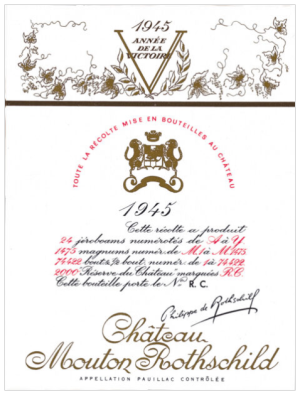
Château Mouton Rothschild 1945, designed by Philippe Jullian to celebrate the Allied victory.
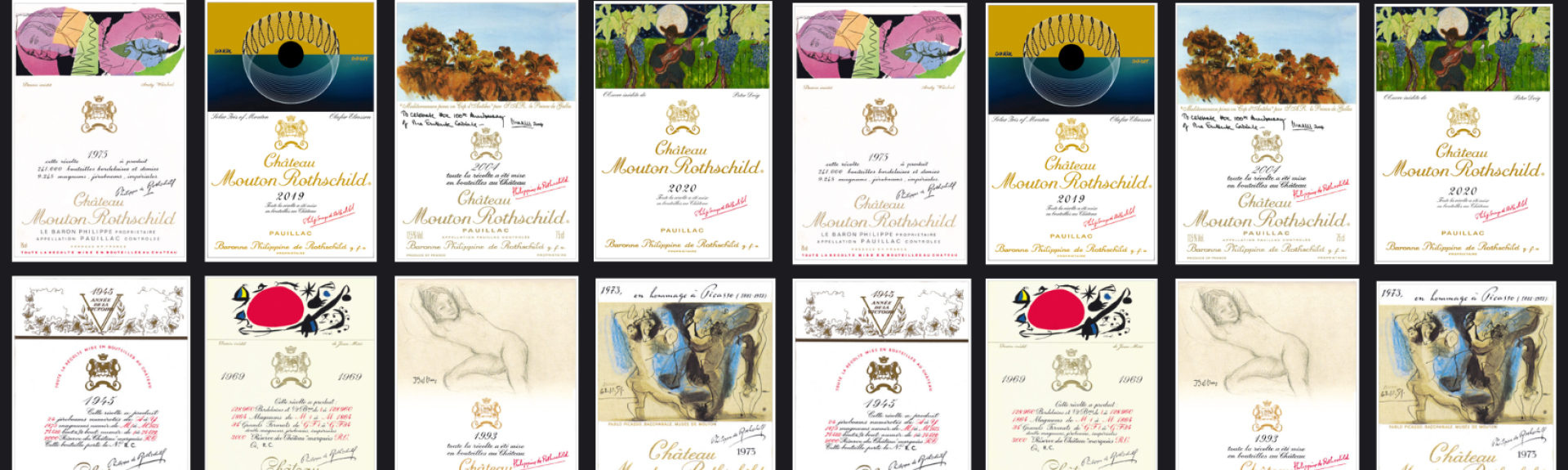
It resurfaced in 1945, with the war just ended. He commissioned Philippe Jullian, then an unknown artist who later found success as a dramatist, to design a label built around Churchill's "V for Victory" sign. From Jean Hugo's 1946 label onward, the commission became an annual fixture, and in the early years it stayed genuinely informal: several designs are said to have started life as quick sketches on café napkins. The artists were never paid a fee, only cases of Mouton, delivered a set on completion and more once their own vintage reached the market.
How an Artist Gets the Call
There has never been a formal brief. Baron Philippe chose the artists himself in the early decades; his daughter, Baroness Philippine de Rothschild, took over after him; today it belongs to her son, Julien de Beaumarchais de Rothschild, who has summed up the guiding principle in one line: the artist "must be like Mouton, an extremely well-known artist who does not need Mouton to promote his or her art."
In practice, that has meant approaching painters and sculptors already at the height of their reputations and then leaving them alone.
Occasionally the invitation ran the other way. Georges Braque is said to have asked to design the 1955 label himself, an approach the Rothschilds welcomed, and his involvement is widely credited with turning the commission from a personal habit into a serious annual event on the art calendar. From then on, designing the Mouton label carried genuine prestige.
What to paint was almost always left to the artist. Some used that freedom to reference the estate directly.
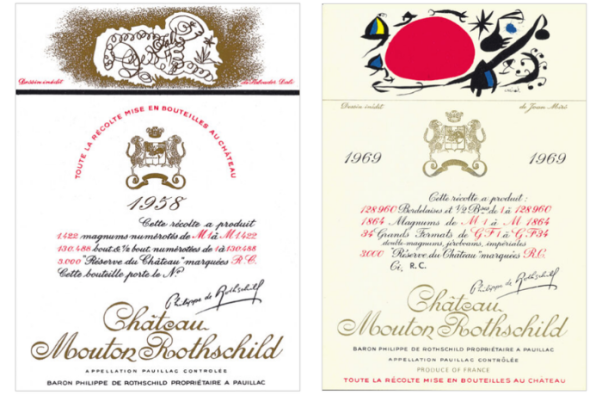
Salvador Dalí’s playful ram for the 1958 vintage.
Joan Miró’s 1969 design, dominated by a vivid red grape.
Salvador Dalí, working on the 1958 vintage, drew a sheep with the innocent charm of a child's drawing, a quiet nod to the château's name: "mouton" means sheep in French, and its crest carries a ram. Joan Miró, in 1969, filled his label with a single vast, blood-red grape, tucking the blue and yellow of the Rothschild family's racing colours into one corner as what the château itself calls "a discreet but witty" salute to his hosts.
When Personal History Entered the Frame
Some years, the theme chose itself. Pablo Picasso died in April 1973, months before that vintage was even harvested. Rather than commission a new work, Baron Philippe turned to a watercolour Picasso had painted in 1959 and kept in his own collection, with Picasso's widow approached to select the piece, inscribed simply "in homage to Picasso." It was also the year Mouton was formally elevated to first-growth status, a coincidence the estate has never let go unremarked.
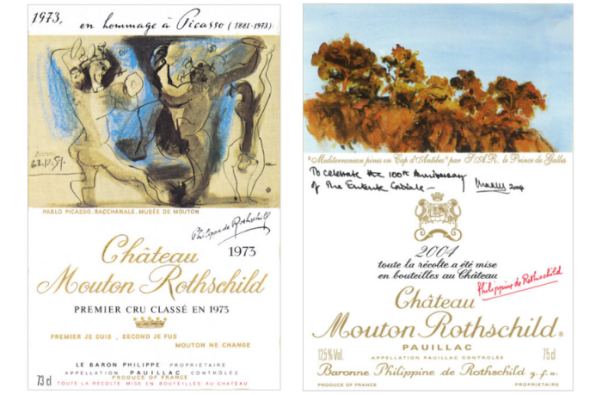
The 1973 label paid homage to Pablo Picasso in the year of his death, and marked Mouton’s elevation to First Growth. The 2004 label featured a watercolour by HRH The Prince of Wales to mark the centenary of the Entente Cordiale.
Four years later, the Queen Mother visited the château in person, and that year's label became a tribute to her stay rather than a commission chosen from afar. The same instinct shaped the 2004 label, created for the centenary of the Entente Cordiale between Britain and France.
Baroness Philippine approached HRH The Prince of Wales, a keen amateur watercolourist and a direct descendant of King Edward VII, who had signed the original 1904 agreement. The Prince let his own painting of a French landscape illustrate the label, adding a handwritten line beneath it marking the anniversary.
When Art Meets Controversy
Not every year passed smoothly. For 1993, Baroness Philippine turned to Balthus, known for his classical, restrained compositions of adolescent girls. His drawing had already cleared approval from the US Bureau of Alcohol, Tobacco, Firearms and Explosives before it reached American shelves.
Once there, it drew enough objection that the Baroness withdrew the bottles from the US market herself and asked the regulator to rescind its approval, then commissioned a second version for American buyers with the same pastel background and Balthus's drawing simply removed.
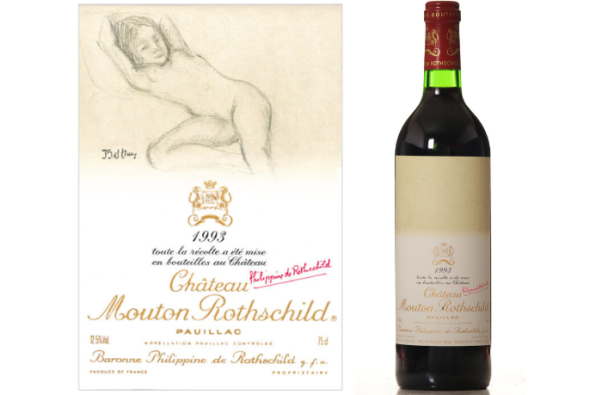
The original 1993 Balthus label (left) and the version released for the US market (right), with the artwork removed.
It remains one of only a handful of Mouton vintages issued with two distinct labels, and bottles carrying the original design are prized today precisely because so few reached collectors before the recall.
Andy Warhol's 1975 label carried a subtler provocation. Working from photographs, as he always did, he juxtaposed several studies of Baron Philippe himself in his signature pop style. The château has since called it a "semi-serious" gesture, one of the few times the label turned its attention to the man behind the estate rather than an abstract theme.
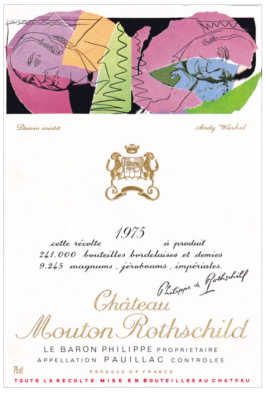
Andy Warhol turned his attention to Baron Philippe himself for the 1975 vintage.
A Living Tradition
The commission has kept adapting long after its founders passed on. For 2019, Olafur Eliasson titled his design Solar Iris of Mouton, describing it as "a map of all the sunsets and sunrises that take place over a year at Château Mouton Rothschild," split into a golden band for day and midnight blue for night.
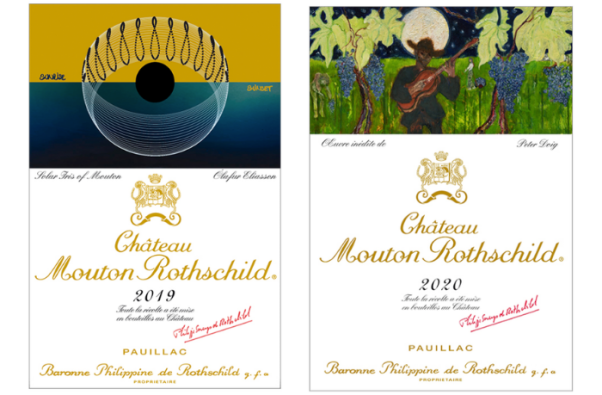
Olafur Eliasson’s Solar Iris of Mouton for the 2019 vintage.
Peter Doig’s artwork for Mouton Rothschild 2020.
A year later, Peter Doig's 2020 label became the occasion for something new: a charity sale with Sotheby's, raising 175,000 euros for Bordeaux firefighters after wildfires had swept the region that vintage. "That is why, as we reveal the artist and the artwork," the estate said at the unveiling, "we decided to organise the sale of an exceptional lot."
For 2023, Portuguese artist Joana Vasconcelos, known for large-scale, exuberant installations, took on the far smaller challenge of working at label size. Her design centres on a cluster of grapes surrounded by symbols of earth, water, sun, and human craft. "My inspiration for the label were the grapes and vines... the naturalistic aspect of the Château Mouton," she has said, "meaning nature, the coherence between nature and man."
Julien de Beaumarchais has echoed the same idea, describing each label as the product of "high-level craftsmanship and at the same time a work of art, because each vintage is unique, rare and hence precious."
Where the Paintings Live
Every original commissioned since 1945 still exists, and none has ever been sold. They live together at the château, in a dedicated exhibition space beside the vat room known as the Paintings for the Labels room.
Since 2013, the collection has hung in a glass display designed by Francis Lacloche, running in order from Jullian's 1945 "V for Victory" to whichever artist most recently accepted the invitation. Visits are by appointment only, folded into the château's guided tours, and photography inside has traditionally been restricted, a rule that has only added to its reputation as one of the more private art collections open to the public in Bordeaux.
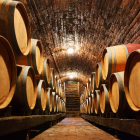
A short walk away sits an older space: the Museum of Wine in Art, built by Baron Philippe and his wife Pauline inside a former barrel hall and opened in 1962 by André Malraux, then France's Minister of Cultural Affairs and later one of the country's most celebrated writers. Its collection has nothing to do with the labels directly.
Instead, it gathers centuries of wine-related art and craft from across the world: sixteenth- and seventeenth-century German gold and silverware, drinking vessels from the treasury of the kings of Naples, woven medieval hangings, and porcelain, glass, and ivory from China, Japan, and Persia.
Together, the two rooms make the same point: wine and art were never treated here as separate pursuits kept apart for marketing purposes, but as two expressions of one idea, gathered under a single roof for anyone willing to book the appointment to see them.
More Than a Label
What ties these stories together is how rarely the label was treated as decoration handed down from above. An artist's death, a royal visit, a wildfire season, a private joke about the family's racing colours: each became a starting point an artist was trusted to run with, largely on their own terms. Eight decades on, that trust is what gives the collection its texture.
For collectors, it means a bottle carries not just a vintage and a name, but a small, specific story attached to the year it was made, one that continues to add to its appeal long after the wine itself has been poured.
Related Articles
70 Years of Unico: What Tasting Vega Sicilia Across 7 Decades Tells You
By Aarash Ghatineh
Wine of Kings, Reinvented: The Dry Furmint Revival of Tokaj
By Alexa Atkinson