70 Years of Unico: What Tasting Vega Sicilia Across 7 Decades Tells You

On Uncorked, my co-hosts reach for first growths, Grand Cru Burgundy, Super Tuscans and cult Napa Cabernet. All of those have a place in my cellar. But when it's my turn to name the wine that got me, it's Unico, the flagship red of Vega Sicilia, a single estate in Ribera del Duero two hours north of Madrid that most drinkers outside Spain have never had a reason to think about.
I've tasted more Vega Sicilia over the years than any other estate I collect, and often the same vintage twice, years apart, to see what's changed. That habit tells you more about a producer than any single bottle can. If you know Bordeaux and Burgundy and are wondering where to look next, or you're newer to wine and wondering why anyone would open the same bottle twice, this is my answer to both.
Older than the appellation
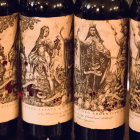
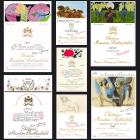
I once had a 1953, a 1959 and a 1973 in the same flight, all wearing the old "Vino Fino de Mesa" label the estate used decades before Ribera del Duero existed as an official region. Alongside them sat a 1957, its label half gone, the wax over the cork cracked with age. You don't get many chances to line up four decades of pre-appellation Unico. Most collectors never do.
What struck me wasn't power. Wines of that age aren't about power. It was how alive the 1957 still was: fruit thinned but not gone, tannin softened into texture rather than structure. Unico isn't released until the estate decides it's ready, usually a decade or more in barrel and bottle, so a 1957 tasted 65 years on isn't a relic. It's doing what it was built to do.
The old labels repay a close look. They list the grapes in the blend, Cabernet Sauvignon, Malbec, Merlot and Tinto Fino, in a way no modern Unico label does. They carry the medals from the 1927 Madrid Christmas Fair and the 1929 Barcelona International Exhibition, still printed forty years later as the estate's credentials. And they give the count: the 1957 was 25,500 bottles, the 1965 was 91,000, each bottle numbered by hand and signed by "El Presidente". Hold one of those next to a 2004 and the signature has changed to "La Presidenta", Marta Álvarez, but the crest, the numbering and the habit of telling you exactly how many bottles exist have not.
The same vintage, twice
I've had the 1996 more than once, most recently poured beside the 2000. Going back to a wine like this isn't about settling an argument; it's a check-in. Second time round, the 1996 had moved from dark primary fruit towards something savoury, with the Tinto Fino underneath showing through more than the Cabernet in the blend. The 2000, four years younger, was still working that out.
Old bottles, serious company
The 1965 came out alongside a Chave Hermitage and an old Sauternes, which tells you where Vega Sicilia sits in serious cellars. The 1975 was a magnum with original artwork on the label, something the estate still does for older large-format releases, and the bottle itself is worth holding before you pour. The 1987 had the same resolved, savoury character as the 1957, with more fruit still in reserve. The 2004 was firmer, more structured. The 2009, the youngest of the group, drinks in a different register altogether: brighter, more direct, still finding its feet.
Valbuena's own case
Valbuena 5º comes from the same estate vineyards on a shorter clock, five years' ageing before release rather than ten. The 2006 already showed real development with fresh fruit underneath. The 2010 I poured next to Almaviva 2012, the Rothschild and Concha y Toro joint venture in Chile, and Tignanello 2012, the wine that created the Super Tuscan category. Valbuena held its own with both. It isn't a lesser Unico. It's Vega Sicilia's answer to what those estates are trying to do on a faster timeline.
Alión, the label the Álvarez family built after buying the estate in 1982, sits in the same territory: younger-drinking, more immediate, and a good way to see how much of Unico's character comes from the vineyard rather than the wait.
A decision, bottled
Reserva Especial always needs explaining before you drink it, because the label carries a release year, not a vintage. Mine was the 2014 release: 52 barrels drawn from the 1994, 1995 and 2000 harvests, blended into 15,546 bottles and signed off by Marta Álvarez as presidenta. It's a winemaker deciding, years after each vintage went into barrel, that three years belonged together. Drinking it feels less like tasting a single harvest and more like tasting a judgement call. The 2025 and 2026 releases are part of our current allocation.
Luis Gutiérrez, reviewing a later release for The Wine Advocate, put the appeal better than I can. He noted that the estate is now holding back more wine so that older vintages can go into the blend, and found in the 2020 release:
"Finesse and some of the Burgundian style of the blends of yesteryear."
Luis Gutiérrez, The Wine Advocate, 98 points
Único Reserva Especial 2020 release (December 2019)
What the labels tell you
Vega Sicilia prints its production on every bottle, so scarcity here isn't a marketing claim. It's a number you can read off the label.
| Wine | Bottles (75cl) | Large formats |
|---|---|---|
| Unico 1957 | 25,500 | |
| Unico 1965 | 91,000 | |
| Unico 2004 | 87,516 | 2,227 magnums, 156 double magnums, 5 imperials |
| Unico 2009 | 74,274 | 3,250 magnums, 209 double magnums, 22 imperials |
| Unico 2016 | 92,292 | 3,695 magnums plus larger formats |
| Unico Reserva Especial, 2014 release | 15,546 | |
| Unico Reserva Especial, 2020 release | 17,071 | 214 magnums |
| Valbuena 5º 2006 | 178,322 | 3,427 magnums, 160 double magnums |
| Alión 2019 | 256,526 | 7,655 magnums, 608 double magnums, 80 imperials, 5 salmanazars |
Read down that column, and the hierarchy explains itself. Alión at a quarter of a million bottles is the wine you can find. Valbuena at 180,000 is the wine you can plan around. Unico at 75,000 to 90,000 is the wine you have to be allocated, and a Reserva Especial release at 15,000 bottles for the whole world is the wine you don't say no to. The estate has been making that point in small print since the 1950s.
How to read a Unico bottle
There's a second reason I photograph every Vega Sicilia I open, and it has nothing to do with sentiment. Fine wine is the only asset where the thing and its packaging are the same object. Nobody can open a 1957 to check it without destroying what they're checking, so everything you know comes from the outside: the label, the glass, the capsule, and the paper trail. The older and dearer the bottle, the more that matters, and the fewer people alive have handled a real one. Vega Sicilia happens to make the job easier than almost anyone, and once you've learned it here the habit transfers.
Lay my bottles out in date order and three label designs appear.
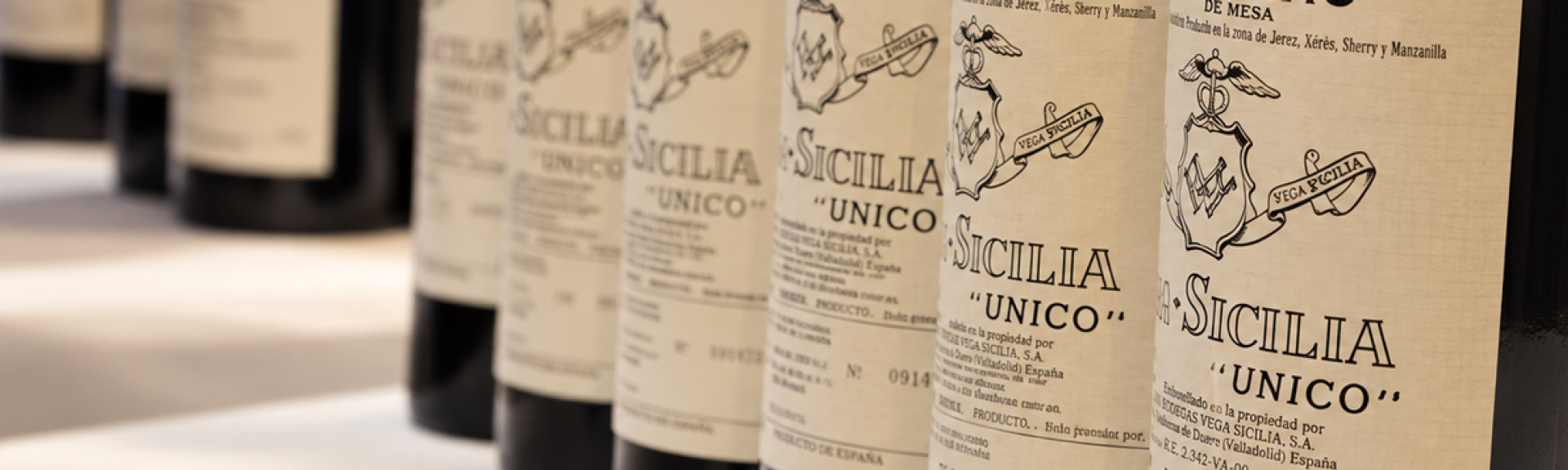
The 1950s to 1970s. The top line reads "Vino Fino de Mesa", because that was the only legal description before the DO existed. Beneath it, in small type, the grapes: Cabernet Sauvignon, Malbec, Merlot, Tinto Fino. Then the winged crest, "Cosecha 1957", and "Unico" in quotation marks, a description rather than a brand. On my 1957 the word is on a separate paper sticker applied by hand, which is right for the period and precisely the kind of detail a printer today would never think to reproduce. Below sits the block of medals from Madrid 1927 and Barcelona 1929, and then the line that does the real work: this vintage consists of 25,500 bottles, and this is bottle number so-and-so, signed by El Presidente. The number has to sit inside the run. A 1957 numbered above 25,500 does not exist.
The 1980s to the early 2000s. Gold-foil crest, "Vega-Sicilia" in gold capitals with the hyphen, and "Ribera del Duero" on the label for the first time. The medals are still there. The production line now includes large formats: my 1996 records 2,235 magnums and 150 double magnums alongside the bottles. This is where most of the tradeable back-catalogue sits, so look at the glass as well: the crest is embossed into the shoulder and "Bodegas Vega Sicilia S.A." runs in raised letters around the base. Both are expensive to fake and both are missing on the counterfeits, which are built on generic Bordeaux bottles.
2004 onwards. The modern label: gold crest, "UNICO 2009" in plain black capitals with no quotation marks because it is now a trademark, no medals, and the most detailed production line yet. The signature has changed from El Presidente to La Presidenta, Marta Álvarez, who took over in 2013. Reserva Especial adds one more check, because the label states the release year and the component harvests: 52 barrels from 1994, 1995 and 2000, 15,546 bottles. Those numbers are published by the estate and can be checked against it.
That's five independent tests on a single bottle before anyone touches the capsule: design matches the era, number sits inside the run, signature matches the president, glass matches the estate, and for Reserva Especial the vintages match the release. One inconsistency is a question. Two are a problem. It's also the reason I'd rather buy an old Unico from bonded stock with a storage history than from a private cellar with a good story, and why every bottle traded on CultX sits in bond at Coterie Vaults, where the warehouse runs its own authenticity checks and photographs the bottle before it's listed. The label tells you what the estate made. The storage record tells you what has happened to it since.
Why the patience matters
Eloy Lecanda y Chaves founded the estate in 1864, trained in Bordeaux, and came home to Castile with Cabernet Sauvignon, Merlot and Malbec cuttings that he planted alongside the local Tinto Fino. It was an odd thing to do in Ribera del Duero at the time, and it is still the decision that gives Unico its structure: around 40% of the vineyard is planted to Bordeaux varieties today. By 1876 the estate was supplying the Spanish royal family. The first wine we'd recognise as Unico came in the 1910s under winemaker Domingo Garramiola, known as Txomin, and the medals it picked up at the 1927 Madrid Christmas Fair and the 1929 Barcelona International Exhibition were still being printed on the label forty years later, which is why you can read them on my 1957 and 1965.
The Álvarez family bought Vega Sicilia in 1982, the year Ribera del Duero gained its DO, and built Tempos Vega Sicilia around it: Alión next door in 1991, Oremus in Tokaj, Pintia in Toro and Macán in Rioja with the Rothschilds. What they didn't change was the clock. Unico still spends around six years in oak, moving from small barrels to large vats, and another four in bottle before release, and it comes out in whichever order the estate judges each vintage ready rather than in sequence; the 1968 wasn't released until 1991, after 23 years. Production stays under 100,000 bottles, most of it allocated to a waiting list. Only a handful of winemakers have run the cellar in that time, with Gonzalo Iturriaga taking over from the 2015 vintage, which is a large part of why a 1957 and a 2009 taste like they came from the same house.
The case in numbers
That's the memory. Here's the data, and for once they point the same way.
- Three Unico vintages, 2004, 2009 and 2010, score a perfect 10 on the Cult Wines Rating, putting them in the top 1% of the c.54,000 wines we track. Across 32 rated vintages back to 1967, Unico averages 95.6 critic points.
- Every Unico vintage on offer with a CWR fair value estimate trades below it, the 2015 by 19.9% and the 2009 by 17.3%.
Recent Liv-ex trades have been clearing above the published market price, with buyers paying up to secure stock. - Reserva Especial has averaged 35.5% five-year appreciation across the eight releases with sufficient history, every one positive.
The full analysis, charts and offer prices are on our Vega Sicilia High Conviction Offer page.
Liv-ex calls Unico "the outperforming underdog", and that's the whole opportunity: scores in the same range as the first growths, priced like Spain's best-kept secret. If you're building around the names everyone knows, this is where the next serious position sits. If you're just starting to look past Bordeaux, Burgundy and Italy, this is where to start.
I've gone back to this wine more often than any other in my cellar, and every time it's told me the same thing the numbers do now: it's worth holding.
Where to start
If you're buying your first Unico, I'd point you at three vintages, for different reasons.
The 2009 is one of the three Grade 10 vintages and the one I've drunk most recently. It carries 98 points from The Wine Advocate, Vinous and James Suckling alike, and I like that Luis Gutiérrez first tasted it blind. He was struck that a year which looked warm and dry on paper had produced something so fresh, found it drinking younger than its age, and picked up on the nose a link back to the old vintages, with softer tannins than those ever had. His verdict was that 2009 turned out far better than he had expected for the estate.
"It has the old Vega perfume: intoxicating, complex and nuanced, full of personality."
Luis Gutiérrez, The Wine Advocate, 99 points (July 2026)
It's the first vintage made wholly under the current winemaker, and if you only ever buy one Unico to lay down for twenty years, this is the one.
For Valbuena, the 2014 and 2015 both sit at Grade 9 and around 32% below fair value. For Reserva Especial, the current 2025 and 2026 releases are the entry point, and given that every rated release has shown a positive five-year return, the entry point matters less than simply having one.
Two ways in
For a portfolio allocation across Unico, Valbuena 5º and Unico Reserva Especial, register your interest in the offer or talk to your relationship manager. To buy individual bottles and vintages directly, browse Vega Sicilia on CultX.
Cult Wines Rating and market pricing correct as of 9 September 2026. Past performance is not indicative of future results.
Related Articles
Wine of Kings, Reinvented: The Dry Furmint Revival of Tokaj
By Alexa Atkinson