Burgundy for People Who Plan to Eat, Drink & Never Leave

I spent three years living and working in Burgundy, and somewhere along the way the region stopped being a list of famous names on a label and became a way of life. This guide is my attempt to help more people understand it, and to genuinely immerse themselves in its terroir and its rhythms.
So, if you are planning a trip, consider this your friendly, slightly mischievous guide. I am not here to hand you a dry list of addresses. I am here to tell you where to eat, where to sleep, and how to avoid the classic tourist mistake of treating Burgundy like a checklist. It is not a checklist. It is a slow, buttery, wine-scented trap, and you should walk into it willingly.
Where to Eat: A Love Letter Written in Butter and Pinot Noir
Let us begin with the obvious: Burgundy is not a region where you “grab a quick bite.” The phrase itself feels borderline offensive here. Even a casual lunch can easily snowball into a three-hour affair involving three courses, two bottles of wine, and an unexpectedly passionate conversation about soil composition.
At the very top of the pyramid is Maison Lameloise in Chagny. It has held Michelin stars since 1926, roughly as long as some local families have been arguing over whether to decant their Chambertin. Under Chef Éric Pras, it remains the region’s sole three-star institution. It is not cheap, and it is certainly not casual. Go if you want to understand why Burgundy takes itself so seriously, and why, just this once, it has earned the right to.
For something a bit more intimate, Auprès du Clocher in Pommard won its first Michelin star in 2026. Tucked right beside the village church, it offers an ideal setup: you can practically repent for your decadent lunch choices the second you step outside. Chef Rémi Genot serves precise, unpretentious five- and six-course menus accompanied by a stellar wine list spanning the breadth of the Côte de Beaune. It is the sort of place where you intend to have “just a single glass” and end up lingering for three hours.
In Beaune, Ma Cuisine reopened in 2026 following renovations under Mathieu Escoffier. While it serves traditional Burgundian comfort food, the real mischief lies in its deep cellar. It is dangerously easy to get adventurous here and order a bottle from a producer you had never heard of.
Meanwhile, Le Carmin holds a Michelin star and occupies a Henri IV–style townhouse near the Hospices. It is refined and seasonal. The kind of spot where you suddenly understand why people use the word “terroir” without a hint of irony.
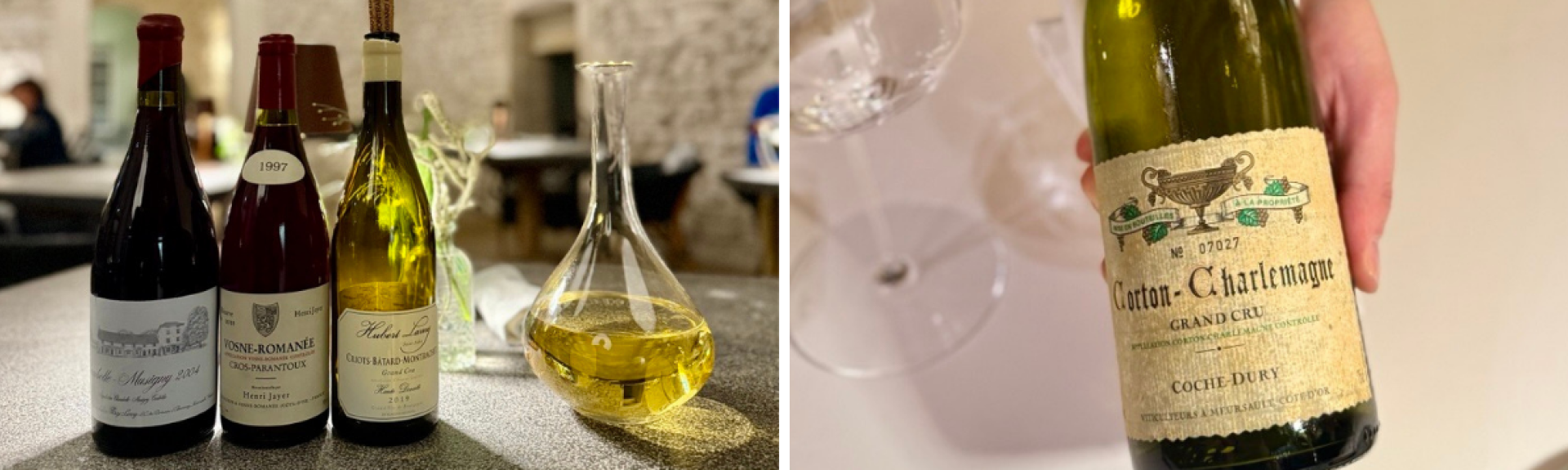
Yet, my heart forever belongs to Caves Madeleine in Beaune. It is the hidden gem winemakers themselves recommend when they aren’t sending you to their cousin’s cellar. Picture a candlelit oak table, a concise menu, and mythical bottles that seem to materialise out of thin air; Domaine Leroy, Pierre Overnoy, or occasionally something entirely non-Burgundian just to keep you humble. You don’t go here to see or be seen. You go to eat exceptionally well, drink even better, and eavesdrop on the table next to you passionately debating fermentation temperatures.
And please, do not leave without paying homage to the classics:
Oeufs en meurette, poached eggs swimming in a rich red wine sauce, is the region’s delicious way of declaring that breakfast can, and perhaps should, be made of wine reduction.
Jambon persillé, a terrine of ham and parsley that looks like an earth science project, tastes like a family feud happily resolved over lunch.
Boeuf bourguignon, beef braised for hours in red wine with lardons and mushrooms, is the dish the rest of the world borrowed. Have it where it was born.
Head to Le Caveau des Arches, tucked inside a 17th-century cellar right at the foot of Beaune’s ramparts, to sample these classics in an atmosphere that feels inseparable from the town’s DNA. Order the bœuf bourguignon, follow it with a proper cheese course, and surrender to the afternoon nap that inevitably follows.
Where to Stay: Vineyard Views and the Art of Rolling into Bed
Burgundy used to carry a slightly unfair reputation: world-class wine paired with somewhat underwhelming accommodations. Thankfully, those days are long gone. The region's hospitality scene has caught up with its cellars, meaning you can now sleep just as magnificently as you drink.
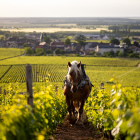
Château la Commaraine in Pommard opened in April 2026 following a five-year restoration, transforming a historic château and working winery into a 37-room sanctuary. With the Pommard Premier Cru vineyard stretching out just beyond the pool terrace, you can sip your wine while watching draught horses peacefully plough the soil beneath the vines. A spa and two restaurants complete the picture.
Around 20 kilometres north, Les Sources de Vougeot occupies a former priory nestled within the historic walls of the Château de Gilly. Located a stone’s throw from the legendary Clos de Vougeot, it allows you to stagger home from a tasting with your dignity intact, or at least with a believable excuse. Its 49 rooms and suites blend heritage architecture with modern luxury, and the Caudalie spa is cleverly housed in the château’s vaulted ancient cellars. Between the fine-dining Clos de la Tour and the more relaxed Auberge des Cîteaux, you can experience the full spectrum of local terroir without ever setting foot off the property.
If you prefer the cosy intimacy of the Côte de Nuits, Hôtel Bellevigne in Chambolle-Musigny is a four-star boutique gem featuring 37 rooms, a refined local kitchen, and a jaw-dropping cellar boasting 1,000 references. It also features a heated outdoor pool, either a brilliant therapeutic idea after a day of tasting or a questionable one, depending heavily on how many glasses you polished off at lunch.
Further south, COMO Le Montrachet in Puligny-Montrachet makes an idyllic base for exploring the Côte de Beaune. They provide e-bikes for cruising through the vines, paired with a restaurant whose sommelier oversees a list of around 1,250 wines. You will try to convince yourself you are cycling to burn off lunch. You aren't. You're cycling purely to justify dinner.
A Practical Frame for the Journey
Burgundy rewards those who refuse to rush. Base yourself in Beaune to tackle the local dining scene and the southern vineyards, then drift north to the Côte de Nuits, villages like Chambolle-Musigny, Vougeot, and Gevrey-Chambertin, to marvel at the grand crus. The Route des Grands Crus connects these essential dots, and many estates happily welcome visitors by appointment. Introductory cellar tours at Château de Meursault and Domaine Faiveley offer brilliant gateways into understanding the region's complex climats. Just try not to corner a winemaker and demand a definition of climat if you're in a hurry.
You aren't in a hurry, anyway. You're in Burgundy.
The most rewarding itineraries weave together one or two lavish meals with simpler local pleasures: a Saturday morning wandering Beaune’s open-air market, assembling an impromptu picnic from a village fromagerie, or spending a lazy afternoon tasting in a quiet family domaine. Burgundy is no longer just a world-class wine region with modest lodgings; it is a place where the dining table, the plush bed, and the vineyard all belong to the very same continuous conversation.
Getting there is easy: Beaune is a little over two hours from Paris by train, often with a change at Dijon, and a car or a driver makes the villages far simpler to reach. Late spring and early autumn are the loveliest times to visit, though many domaines pause visits during the harvest (usually September), so check before you plan a trip around a tasting. If you can, time your stay for the third weekend of November, when the Hospices de Beaune charity auction turns the whole town into a festival. Whatever the season, book the top tables and estate visits several weeks ahead.
A Note for Collectors
Walk the Route des Grands Crus and you will quickly see why Burgundy behaves the way it does in the market. Its greatest vineyards are small and divided between many growers: Clos de Vougeot’s 50 or so hectares are shared by around 80 owners, and some grand cru holdings amount to just a few rows of vines. Many of the most coveted cuvées are made in quantities of a few hundred cases or fewer, which is why bottles from the top climats are so hard to find and why they have long been among the most sought-after wines on the secondary market.
For collectors, a visit is worth more than any tasting note. Meeting the growers, seeing how one side of a lane can differ from the other, and learning which villages and producers people are talking about is the best preparation for buying well. Just remember that many of the most famous domaines sell little or nothing at the cellar door, so the wines that impress you most on the trip may be easiest to secure once you are home.
I arrived in Burgundy thinking I knew its wines and left with a bulging cellar, a few extra kilos, and a permanent, deeply ingrained suspicion of anyone who claims they “did Burgundy in two days.” You cannot “do” Burgundy in two days. You can only begin.
So, book the room, reserve the table, and prepare to be fashionably late for everything else in life. The wine will explain.

Related Articles
Porto and the Changing Face of Port
By Sean Wright
A Journey Through Burgundy: Four days on the Côte d’Or
By Tom Turner
Georgia: The Ancient Homeland of Wine
By Jessie Wu