Rioja Rewards the Patient: A Week Inside Seven Great Cellars

In November, a small group of Cult Wines clients spent a week in Rioja with us.
Seven cellars, a barrel maker, a hand-dug cathedral of wine and a 25-year-old Aro later, one lesson stood out: in Rioja, the best things are worth waiting for.
Where the railway met the wine
In the 1880s, phylloxera was destroying the vineyards of France. Bordeaux merchants came south looking for wine, and the new railway line at Haro gave them a way to ship it home. Within a few years, a cluster of bodegas had grown up around the station. Locals still call it the Barrio de la Estación, the Station Quarter, and it may have more great wine per square metre than anywhere else in Spain.
That little district was our base for most of the week. We stayed across the Ebro at Palacio Tondón in Briñas, five minutes from the station, and spent our days walking from one historic gate to the next. Five of the seven wineries we visited sit within a short stroll of each other. The other two took us east into Rioja Alavesa, where the vineyards climb towards the Sierra de Cantabria.
What connected them all was patience. Barrels seasoned for years before they hold a drop of wine. Gran Reservas that spend six years in oak. A family that releases a vintage only when it feels ready, even if that takes decades. Rioja is a region that plays the long game, and by the end of the week, so were we.
CVNE: a welcome under Eiffel's roof
Our first evening began with Rioja's most famous typo. In 1879, two brothers founded the Compañía Vinícola del Norte de España and sensibly shortened it to C.V.N.E. Someone read the V as a U, "Cune" was born, and it stuck. It is now one of the best-selling Riojas in Spain.
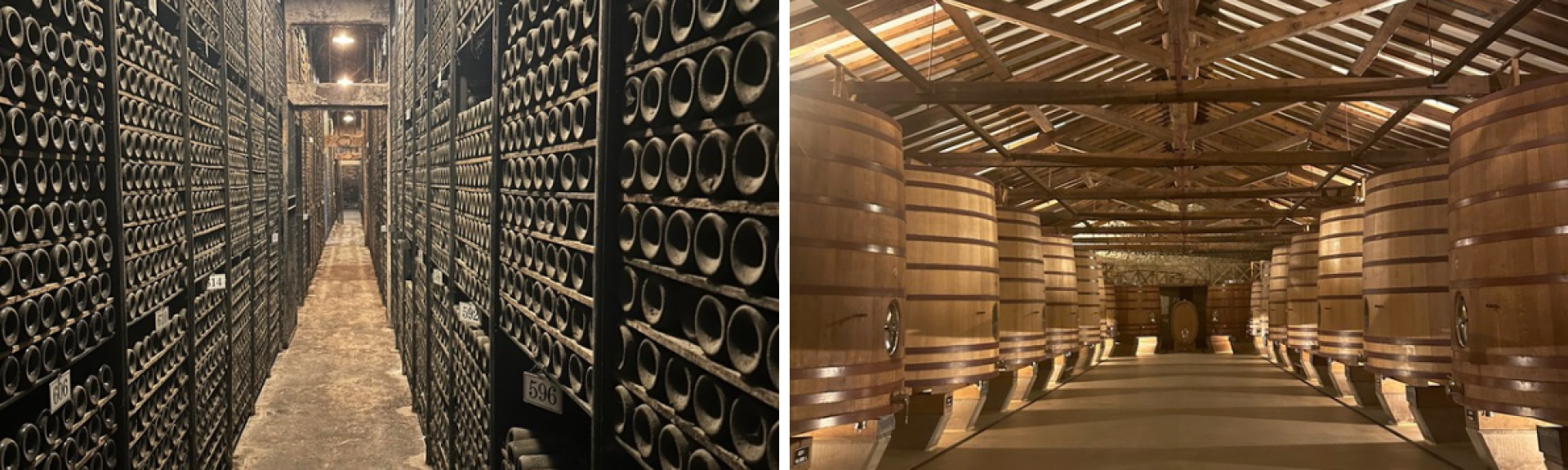
The barrel hall is worth the trip on its own. Its roof is credited to Gustave Eiffel's studio, and there is not a single column holding it up, just steel trusses running from wall to wall. Below ground is the cellar the team calls the "cemetery", where mould-covered bottles going back to 1888 rest in stone niches, the oldest behind bars. Local legend says that after one long party down there, the guests agreed those bottles could only be opened by whoever returned 100 years later.
Dinner was bacalao a la riojana, the region's classic salt cod with peppers, served with two wines that show CVNE's range:
- Imperial Reserva 2019: The flagship, made only in excellent years from vines over 40 years old. The name comes from the "imperial pint" bottles once shipped to England. Blackberry and blueberry over liquorice, cocoa and pepper, plush but polished, with a long mineral finish.
- Monopole Clásico 2022: Monopole has been making wine since 1915, which makes it Spain's oldest white wine brand. The Clásico ages under a veil of flor in old sherry casks: green apple, lemon and orange blossom, then a salty, nutty twist that had everyone reaching for the olives. Rioja dressed up as Sanlúcar, and somehow it works.
Muga: the family that builds its own barrels
Most wineries buy their barrels. Muga makes them. The family business, founded in 1932 by Isaac Muga and Aurora Caño and now run by the third generation, works from a 200-year-old building in the Station Quarter, and its cooperage was the moment our group fell silent.
Muga says it is the only winery in Spain with its own master cooper, who works alongside three barrel makers on site. They buy French trees at auction, then season the staves at the winery for years before a single barrel is built. Around 2,000 barrels leave the workshop each year, along with the giant wooden vats, up to 15,000 kg, where every red wine ferments. Nothing here touches stainless steel. Wines are moved by gravity rather than pumps and fined with fresh egg whites, as they have been for generations.
Why does it matter? Oak is one of the biggest influences on the style of Rioja. By controlling it from the forest to the bottle, Muga gets a consistency of oak handling that runs right through the range. You could taste it, from the barrel-fermented whites to the Gran Reservas.
In the glass. The Flor de Muga Rosé 2025, from 70- to 90-year-old Garnacha bush vines, converted a few rosé sceptics with its peach, apricot and fine, fresh texture. The Prado Enea Gran Reserva 2019 comes from the last vineyards in Rioja to ripen, at up to 700 metres, and spends at least three years in oak and three in bottle: black cherry, cedar and cinnamon, silky and very soft.
The surprise of the morning was a sparkling wine. Cava is not only made in Catalonia, and Muga's Conde de Haro Gran Reserva Millésimé 2013, riddled by hand, was broad and creamy, with toast, baked apple and nutty notes. It sells for €95 at the cellar door.
Lunch at the bodega was the best kind of history lesson. Three older bottles showed exactly where Muga's wines are heading:
- Aro 2001: Muga's modern icon, from vines at least 60 years old, in only its second vintage, with around 250 cases made. Twenty-five years on it still felt young: dark cherry, violets, tobacco and leather, with dense fruit and elegant tannins. James Suckling scored it 97.
- Prado Enea Gran Reserva 2001: Powerful and tightly wound in its youth, now right in its drinking window, with cedar, forest floor, dried red fruit and a long, mouth-watering finish.
- Selección Especial 2006: Twenty years old and fully savoury, with forest floor, cinnamon and leather: a clear picture of how Muga's Reserva-level wines age.
The keepers of classic Rioja
A few doors down, two houses make the case that the old way is still the best way.
La Rioja Alta: trends come and go, American oak stays
La Rioja Alta was founded in 1890 by five Riojan and Basque families, and in 1904 it merged with the Ardanza winery. Those two dates live on in its most famous wines, the Gran Reserva 890 and Gran Reserva 904. While much of Rioja moved to French oak, this house never wavered. It imports American oak, seasons it outdoors for about two years, builds its own barrels and racks every wine by hand, barrel to barrel, every six months.
Rather than change the house style to follow fashion, the family bought other estates, including Torre de Oña in Rioja Alavesa, Áster in Ribera del Duero and Lagar de Cervera in Rías Baixas. Why change a classic when you can buy a new one?
Our favourite story was the underdog 1997. It was a rainy, difficult harvest, and the team didn't think it was good enough for the 904. A few years in barrel changed their minds, and it became a 904 after all.
- Viña Ardanza Reserva 2020: The house favourite: Tempranillo with around 20% Garnacha, each aged separately in American oak. Red cherry, raspberry and warm baking spice.
- Gran Reserva 904 2016: Four years in oak from a top vintage for both quality and quantity. Dark fruit, tobacco, vanilla and silky tannins. A textbook classic.
- Gran Reserva 890 2010: The wine that made everyone smile. Made only in exceptional years, it was the first 890 since the legendary 2005, with six years in oak and ten hand rackings. Dark fruit, leather, dried orange, forest floor and cocoa.
R. López de Heredia Viña Tondonia: Rioja's time machine
Some wineries modernise. López de Heredia looked at the 21st century, shrugged and carried on as if it were 1877, the year Rafael López de Heredia founded what is now the oldest winery in Haro.
Fermentation still happens in 18,000-litre wooden vats, and some of the presses date from the 1920s and 1940s. Ten metres underground, the hand-dug "Cathedral of Wine" stretches through tunnels up to 200 metres long, holding around 13,000 American oak barrels. None of them are new, and the in-house coopers label each one with its life story. The cellar walls are thick with mould and cobwebs, and nobody touches them: they help keep humidity and temperature steady.
Winemaker Mercedes López de Heredia puts it down to patience and love. Wines are released only when the family thinks they are ready, and sometimes that takes decades.
- Viña Bosconia Reserva 2015: From the El Bosque vineyard beside the Ebro, about five years in old oak. Ripe red cherry, strawberry and sweet spice: the bold one.
- Viña Tondonia Reserva 2015: From the flagship vineyard, planted in 1913, with six years in barrel. More savoury and structured, elegant rather than loud.
- Viña Tondonia 2001: The showstopper. Pale maroon and still fresh at 25, with dried strawberry, tea leaves, forest floor and leather. Great Rioja doesn't fade; it just gets more interesting.
Roda: the new kid on Rioja's oldest block
Most of the Station Quarter was built in the 1800s. Roda arrived in 1987 and still made everyone pay attention. The name joins its founders, Mario Rotllant and Carmen Daurella, and their perfectionism showed from day one: the first vintage, 1992, was held back four years before release.
Roda puts around 7% of its turnover back into research and has identified more than 500 clones of Tempranillo, kept in a gene bank that other growers can use too. That's not a winery, that's a library. The vineyards are old, dry-farmed bush vines cooled by the Cierzo wind, and in the cellar the aim is fresh fruit first: native yeasts, short skin contact and comparatively short ageing, with no Gran Reserva in sight. Here, oak is the seasoning, not the main course.
- Roda I Reserva 2011: The dark-fruited side of Tempranillo, from a warm, low-yielding year. Fifteen years on: black berries, violets and a mineral streak, with real clarity. James Suckling gave it 98 points.
- Cirsion 2022: Roda's emblem is a thistle, and its top wine takes its name from the Latin for it. Only bunches whose tannins are already silky on the vine make the cut, so it needs just eight months in new French oak. Dark, juicy and voluptuous, with only 7,523 bottles made.
- Roda I Blanco 2022: Roda's first white took years of trial and error. Old-vine Viura, 18 months in large oak casks: grapefruit, quince and white peach, creamy and vibrant. Not a summer sipper, but a serious white built to age.
Into Rioja Alavesa
Midweek, we crossed into the Basque side of Rioja, where medieval villages sit on terraces below the Sierra de Cantabria. It gave us the two most different visits of the week: one tiny and obsessive, one famous around the world.
Remírez de Ganuza: from butcher's block to barrel
Fernando Remírez de Ganuza started out in his family's meat business, then spent 20 years as a vineyard broker, buying and selling plots until he knew every good vine in Rioja by heart. In 1989, aged 39 and with no winemaking experience, he founded his own bodega in the village of Samaniego. Clearly, he knew a prime cut when he saw one.
The butcher's precision is everywhere. Grapes are picked into 10 kg crates, chilled and sorted twice, then every bunch is cut in two. The riper "shoulders" go into the Reserva and Gran Reserva, and the "tips" become Erre Punto, a young carbonic red. The grapes are rinsed in juice from berries that split during sorting, not tap water. White wine barrels sit on wheels and rails and are rolled twice a week, so the lees are stirred without the barrel ever being opened. And the top red is pressed by a giant bag slowly filled with water.
- Trasnocho 2020: The "water balloon" wine, pressed gently and aged 20 months in French oak. Ripe black fruit, balsamic and toasty notes, creamy and full-bodied.
- Gran Reserva 2016: Only the shoulders of 60-year-old vines, with about 40 months in new French oak. Ripe cherry, violets and an incense-like edge, the oak beautifully woven in. Ten years on, it's just getting into its stride.
- Fincas de Ganuza Reserva 2018: The approachable sibling, from younger vines with the same obsessive selection. Dark cherry, wild herbs and liquorice, silky and fresh, at a friendlier price.
Marqués de Riscal: a winery in a party dress
In 1858, Camilo Hurtado de Amézaga, the Marqués de Riscal, came home from Bordeaux with French know-how and 9,000 vines, and his first vintage followed in 1862. Today the estate at Elciego is impossible to miss, thanks to Frank Gehry's hotel and its ribbons of titanium.
The story goes that Gehry wasn't sure about building in a vineyard until his hosts opened a Riscal from 1929, his birth year. The ribbons are coloured like a Riscal bottle: pink for the wine, gold for the famous wire mesh and silver for the capsule. Riscal also hosted the main celebration of the Rioja appellation's 100th birthday in June 2025, with King Felipe VI, and opened bottles of the 1925 vintage for the toast. And that golden mesh, first added to stop fraudsters refilling bottles, is gone from the 2020 Reserva onwards, saving around 14,000 kilos of brass wire.
- Sublimme by Riscal: After 168 years, Riscal's first-ever sparkling wine: 100% Sauvignon Blanc from its old vines in Rueda, aged on its lees. Light at 11.5%, zesty and fine, made for oysters or an aperitivo.
- Reserva 2021: The classic, and the wine behind the Gehry colours. Mostly Tempranillo with a dash of Graciano, about 20 months in American oak: dark fruit, liquorice, vanilla and a gentle balsamic finish.
- Barón de Chirel 2020: Riscal's tribute to its Bordeaux roots, first made in 1986. Tempranillo with a little Cabernet Sauvignon from 80- to 110-year-old vines. Blackcurrant, graphite, violets and cocoa: Rioja with a French accent.
For the collector
A week of older bottles is the best argument there is for buying great Rioja young and giving it time. A few things worth keeping on your radar:
- Prado Enea 2019: Tasting the 2001 alongside the current release showed how Muga's traditional flagship rewards patience. 2019 was rated an Excellent vintage in Rioja.
- La Rioja Alta Gran Reserva 890: Made only in exceptional years, with 2010 the first release since 2005. Rarity is built in.
- Aro: Tiny volumes and top scores make Muga's modern icon a genuine collector's bottle, and the 2001 shows it can age for decades.
- Muga in Ribera del Duero: The family has bought vineyards in Ribera and is building a separate winery there. One to watch.
The long way home
Seven cellars in a week could easily blur into one. These didn't. Muga builds its own barrels; Roda builds a library of vines; López de Heredia barely changes a thing. Yet the wines that stayed with us, the Aro 2001, the Tondonia 2001 and the 890 2010, had one thing in common: someone, years ago, decided to wait.
That is the quiet secret of Rioja. In a world that moves fast, the region's best houses still season wood for years, rack by hand, and release a wine only when it is ready. Spend a week in their cellars, and you start to understand why the wait is worth it.

Related Articles
Burgundy for People Who Plan to Eat, Drink & Never Leave
By Mengyan Zhu
Porto and the Changing Face of Port
By Sean Wright
A Journey Through Burgundy: Four days on the Côte d’Or
By Tom Turner